
August 18, 2026, Sebastopol, California
(last updated September 20, 2026)
 I’ve been a business reporter for 40 years and a repo blogger for 15. But today I’m so worried about a coming financial crash that I’ve begun giving talks to try to connect with Main Street Americans.
I know Main Street Americans pay no attention to my blog or the repurchase market. They are not going to pressure Congress to fix repos. And that’s a big problem.
Runaway repos are a key cause of two crises facing Americans today:
- Our rich are getting super rich, while other Americans feel stuck.
- Our financial markets are unstable, dependent on ongoing Federal Reserve bailouts that make the rich richer while raising the question: How long can Fed bailouts prevent the next crash?
Repos are to blame because repos are the core financing for the financial markets that cause these problems, and repos are vulnerable to runs.
So maybe if I talk to people:
- make it simple
- focus on the wealth divide, not repos
- give key nonpartisan fixes, which few analysts mention
- stress that both Republicans and Democrats say in recent platforms that they want to bring back the Glass-Steagall Act, which is my No. 1 fix
Maybe that will help?
OK, I’ll try. I’m no speaker. I’m a scribbler. But what the heck? Let me know what you think.
Below is a link to a recording of a talk I gave recently at the Osher Lifelong Learning Institute at Sonoma State University in Rohnert Park, Calif., and following it are my supporting documents.
Even though my whole purpose is to fix repos and prevent the next financial crash, in my talk I only mention repos at minutes 10:26 and 1:35:11. Sneaky, huh?
If you watch this video, skip the first three minutes, when the host wrestles with the microphone, and the 14-minute break we take at 1:07:13 – 1:21:14.
OR just read the supporting documents below, which include much more detail and sources.
Following are the supporting documents:
THE ROARING 2020s
Rising wealth inequality and unstable financial markets
- How they’re connected
- What’s causing it
- How to fix it.
The deregulation of financial markets during the past 50 years was intended to help the U.S. economy thrive and grow. Instead, it is creating a wealth gap and a shadowy financial system that now threaten the stability of our nation. Ten simple nonpartisan steps by Congress can get America headed in the right direction again and prevent the next financial crash.
(If you see mistakes, please let me know. I’m a reporter, I’m always learning.)
Mary Fricker
mfricker@sonic.net
http://www.RepoWatch.org
WE CAN FIX OUR FUTURE
America, we got this
See below:
- SIDEBOX #1: What is banking and investing
- SIDEBOX #2: Central bank bailouts
- SIDEBOX #3: Books on Inequality and Financialization
- SIDEBOX #4: My 10 fixes
- SIDEBOX #5: Who is Mary Fricker?
America, we can fix what went wrong.[1]
The problem is clear: We’ve become a Land of Un-Equal Opportunity, where the wealthiest 10% of Americans get almost half the nation’s income and have two-thirds of the nation’s wealth. [2]
We are an eerie image of the Roaring 1920s. Some historians warn we may be approaching a breaking point, a 1929-style crash with catastrophic losses.
Why? A key reason is that for 50 years both parties in Washington have been deregulating finance,[3] favoring Wall Street over Main Street and creating an unseen world of money that is out of control.
This has caused two dangerous problems:
- Our rich are getting super rich[4] while other Americans feel stuck[5]
- Our financial markets are unstable and dependent on ongoing Federal Reserve bailouts[6] that keep making the rich richer while raising the question: How long can Fed bailouts prevent the next crash?
When we look to Congress for help, we discover it’s impotent. So we look to strongmen.[7] In fury, we demand, “Make AmericaNS Great Again.” But we know that a quick fix is no fix. Congress created much of this problem.[8] Congress must make it right.
This is not rocket science. Researchers have been documenting these problems for years.[9]
Ten simple nonpartisan fixes, that are fair to everyone, can get America headed in the right direction, encourage Wall Street and Main Street to work together again, and prevent the next financial crash.
One party can’t do this alone. Both Republicans and Democrats need to be on board.
Our timing is good. Both political parties now say that their #1 goal is to help middle Americans.
I say, prove it. It’s time to move beyond the blame game and get busy.
America, we got this.
(See below for SIDEBOX #4, a simple list of my 10 fixes.)
What went wrong?
First, let’s take a look at how we got here, because that shows the way forward.
It all started 50 years ago. [10] The 1973-1975 recession was the worst since World War II. Investments in production, business inventory and housing fell 40%. By 1980 interest rates were at 20%,[11] in 1981 the annual interest on 30-year fixed-rate mortgages hit 18.4%,[12] and in 1982 unemployment hit 10.8%.[13]
Congress’s response was to try to goose the economy by slashing regulations on finance,[14] favoring investors over wage-earning Americans.
After Americans chose Ronald Reagan in 1980, the effort escalated. It continues to this day.[15]
Over time Congress made it easier for people who buy, sell and trade things like stocks, bonds and real estate to use lots of borrowed money and very complicated deals – like hedges and derivatives and special purpose vehicles, things many Americans never heard of – to make a lot of money.
Congress didn’t deregulate business much.[16] Our small businesses and working Americans still chafe daily against regulation. [17] Instead, Congress lowered taxes and regulation to free up money.[18]
And with that money, financiers have created a world that most Americans never see, a world that makes a lot more money for insiders by ratcheting up the risk on Wall Street while cushioning their losses.
- Today the business of finance creates only 4% of our jobs, but it gets 23% of our nation’s profits.[19]
- In the past 28 years, we’ve had to bail them out eight times [20] to protect our economy from the collapse of their risky deals.
We have a runaway Wall Street that often turns its back on the Main Street Americans it used to serve.[21]
So, what is finance?
For many people, finance is a mystery. But mainly it’s banking and investing. A financial company is a company where the product is money, like a bank or a stock broker.
In banking, your money is stable. In investing, it goes up and down.
(See below for SIDEBOX #1 on banking and investing.)
Banking and investing companies are essential to Americans’ well being.
But the opaque and interconnected world Congress has let them create since 1980 is not.
In that unseen world of finance, giant banks, investment firms and others – sometimes called shadow banks[22] because they’re not as carefully regulated and transparent as banks[23] – lend, borrow, buy, sell, invest, speculate, hedge and gamble with each other and with banks,[24] creating an interconnected web of risky deals.
This chart is a drawing of the Shadow Banking System by a Federal Reserve economist.. (24)
Who are the shadow banks? Shadow banks include money market funds, hedge funds,[25] asset managers, insurance companies, pension plans, mutual funds, investment banks, non-bank subsidiaries of giant banks, private equity and private credit[26] companies, broker-dealers, large businesses, finance companies, mortgage lenders, endowment funds, real estate investment trusts, business development companies,[27] private investment firms[28], sovereign wealth funds, trust companies,[29] mortgage servicing companies,[30] government investment pools,[31] private liquidity funds,[32] securitization vehicles,[33] collateralized loan obligation vehicles,[34] fintech companies,[35] private debt providers,[36] special purpose vehicles,[37] asset-backed commercial paper (ABCP) conduits,[38] limited-purpose finance companies,[39] structured investment vehicles, [40]credit hedge funds,[41] government-sponsored enterprises,[42] and primary dealers,[43] so-called because they’re selected to deal directly with the Fed…. just about anything that borrows and lends but isn’t a commercial bank.[44]
Every day these shadow banks conduct trillions of dollars of deals worldwide.
For example, every night large firms make $8 trillion in so-called “repo” loans to each other, and those repo loans have to be paid back the next day, unless the lender agrees to roll them over for another day.
Repos are the unseen money that finances the unseen financial markets I’ve been writing about. [45]
“Yes, that repo, the $13 trillion that sits in the deepest, darkest depths of Wall Street’s plumbing, where financial firms borrow and lend cash against securities for short periods of time. The kind of market that the average person blissfully won’t ever have to contemplate, but that is essential to keeping the other more shiny ones going,” said reporter Anna Irrera for Bloomberg.[46]
Repo is a dangerous market vulnerable to collapse. And today the volume of repo loans, which fell by more than half after the crash of 2008, is soaring again and now exceeds 2008 levels.[47]
I blog about repos at repowatch.org., in case you’re interested.[48]
Repos are why we crashed in 2008.[49]
Our biggest bank, JP Morgan, demanded sudden repayment[50] of its repo loans from investment bank[51] Lehman Brothers.[52] Lehman couldn’t immediately repay, and it failed.
So what? Companies fail. That shouldn’t have been a problem.
But deregulation of finance has let financial firms get so interconnected with deals[53] that failures quickly spread worldwide. That’s because when a company fails, it can’t repay its lender …. and then that lender can’t repay its lender …. and so on.
With the collapse of Lehman Brothers, our financial markets crashed.[54]
Regulators intervened, JP Morgan got its money back and came through the 2008 crash and ensuing Great Recession just fine. In fact, it has grown from $2.2 trillion in assets in 2008[55] to $4 trillion today.[56]
Instead, middle America paid the price.
Before Congress deregulated finance, only regulated and self-insured (FDIC) banks could do the riskiest business. To this day, banks have to pay for their own bailouts, with their FDIC insurance which they themselves buy.[57]
But now shadow banks with no FDIC insurance and not much regulation can do the risky business, too.[58]
That’s why the Federal Reserve, which used to have to be responsible only for banking, now also has to babysit the volatile world of investing,[59] which in the U.S. has grown three times bigger than banking since the 1980s. [60]
And that’s why I want to re-regulate finance. Like the Fed, I’m trying to prevent the next financial crash.
Inequality is also rising
Meanwhile, inequality in the U.S. has also been rising since 1980.
Wealth inequality, 1990-2026
 https://fred.stlouisfed.org/release/tables?rid=453&eid=813668
Shaded areas indicate U.S. recessions
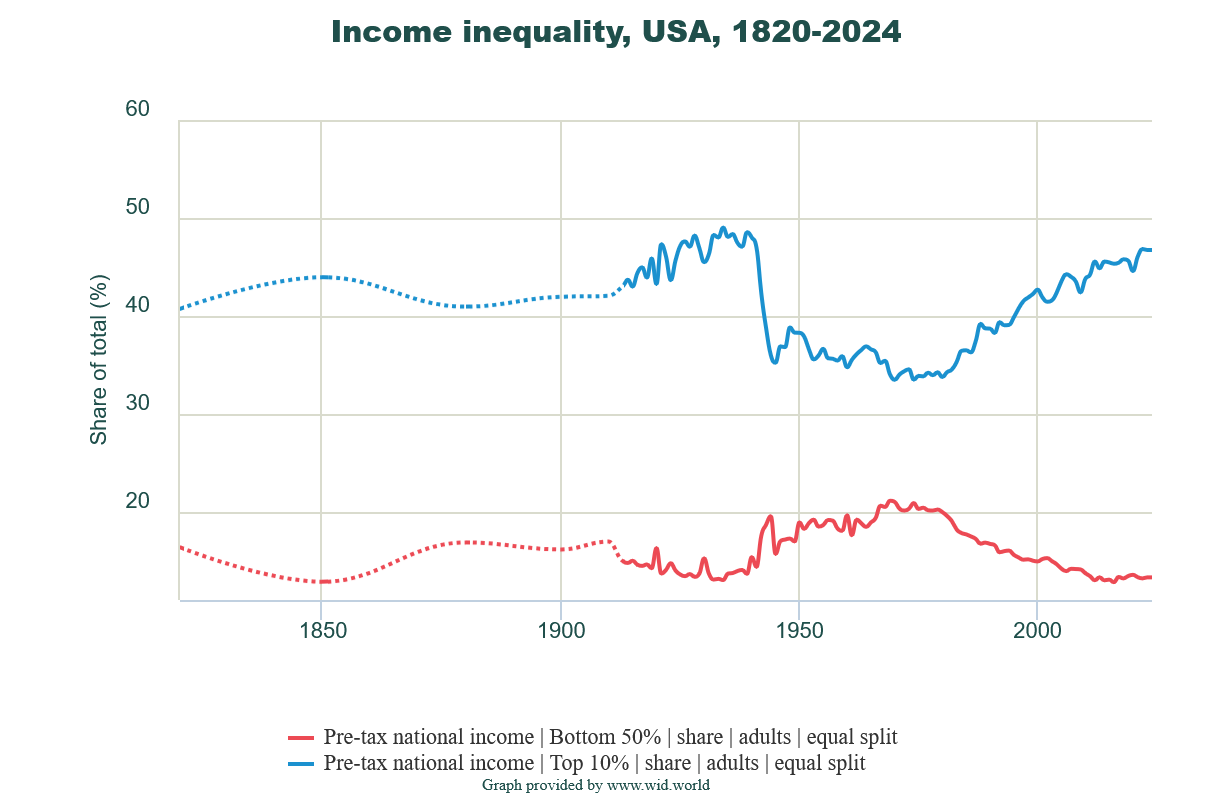
- Top line: Pre-tax national income, Top 10% share
- Bottom line: Pre-tax national income, Bottom 50% share
- https://wid.world/country/usa
Years of rising income inequality is a key sign of a coming market crash, recent economic studies show.[62]
“Inequality over time and in many nations is the most effective predictor of financial crises,” said the late[63] financial consultant Karen Petrou.[64]
And, sure enough, in 2008 we had the first economic crash since 1929.
Yes, we had had big stock market ups and downs, like 1987 and 2000, but 1929 and 2008 were different. (64)
In 1987 and 2000, the value of stocks fell, hurting investors. In 1929 and 2008, firms couldn’t repay their loans from other firms, and banking and investing were so interconnected and risky that when some deals failed, the whole market crumbled.
The collapse devastated all markets and all Americans and left us with the Great Depression of the 1930s and the Great Recession of the 2010s.
In the Great Recession, more than eight million Americans lost their jobs, the unemployment rate rose to 10%, and the net worth of American households fell by more than $10 trillion in 1½ years.[65] The recession was the deepest since World War II.[66]
The Federal Reserve shoveled trillions of dollars of cash into financial companies to stem the losses and soon finance was back in business.
But for many on Main Street, the economy still languishes nearly 20 years later, [67] compounded by COVID.
And inequality is soaring once again. [68]
This year the wealthiest 1% of Americans has the same net worth as the bottom 90%, according to the Federal Reserve.
Pleading for help
Since 2008 Americans have been pleading for help. The Tea Party, Occupy Wall Street, bouncing between Republican and Democratic presidents,[69] landing most recently with President Trump, a strongman, all have been signs of fury.[70]
Americans know something has gone terribly wrong.
Yes, globalization, technology, the pandemic, and other forces played a role.[71] But something else isn’t right.
When an economy is overwhelmed by finance,[72] that has a name.
It’s called financialization.[73]
The result of financialization in the U.S. has been income inequality and financial instability.[74] From housing[75] to health care,[76] the benefits today often flow to financiers.
“Perhaps the most underappreciated transformation of the past 40 years is the corporate consolidation and financialization of medicine. Care delivery – once local and community-based – is now dominated by corporations,” said Katelyn Jetelina and Hayden Rooke-Ley in their substack column YourLocalEpidemiologist.[77]
Financialization in the U.S. must be unwound.[78]
Bring back our jobs
In today’s troubled times, what worries Americans the most?
Multiple studies show Americans’ biggest worry is getting and keeping a good job.[79] They can’t see how they’re going to be able to support their families and build careers and wealth over time. [80] They feel like their American Dream is slipping away.[81]
Deregulation of finance has cost us good jobs in many ways.
For example, companies have discovered that with today’s laws they may be able to make more money by moving money around,[82] by lending, borrowing, and trading, than they can make by creating and producing goods.[83]
General Electric was one of our nation’s greatest creators and producers for decades.[84] But in the 1980s GE management financialized, starting GE Capital, a bank that grew to account for almost two-thirds of GE’s profits.
The bank went into credit card lending, mortgage lending, insurance sales and real estate.[85] In 30 years 1981-2011, General Electric eliminated 158,000 U.S. jobs, almost half of its domestic workforce.[86] GE’s stock price soared. Executives, shareholders and finance wizards were delighted.
But in 2008, finance had a crisis, and General Electric had to turn to emergency cash from investors and programs created by the Federal Reserve and the FDIC to survive.[87] In April 2024 the last of GE was broken up into lots of pieces, and today the iconic General Electric, GE Capital and thousands of their jobs are gone.[88]
Here are other examples of how finance, and its focus on money, have hurt jobs.
- Tax havens: Companies and the wealthy, while enjoying the multiple benefits of being in the U.S., take profits and jobs to tax havens abroad to avoid taxes, a dodge that has accelerated significantly since the 1990s.[89] Or, increasingly, they can do the same thing in the U.S., by hiding their wealth in structures like trusts.[90]
- Share buybacks: Executives use profits to buy their company’s shares [91] and enrich shareholders, which was largely illegal until 1982,[92] instead of using those profits to increase production or employees’ wages and training.[93]
- Private credit and private equity: Investors today seem to love private companies that exploit tax deductions to buy or finance other businesses, lay off those employees to reduce costs, sell equipment and property for a quick profit, [94] and escape most Securities and Exchange Commission oversight because they’re private, not public.[95]
This does make me wonder: How much of our loss of jobs is caused by illegal immigration and globalization and how much of it is really caused by financialization?
Thanks, Fed
A key difference between today and 100 years ago, a benefit that is buying us some time, is a Federal Reserve much better equipped to fight financial panics.
The Fed had to do some hand holding in 1998[96] and 2001,[97] as signs appeared that deregulated finance was making financial markets dangerous. Then, in 2008 the Fed learned a tough lesson.
Financial markets started to wobble, and the Fed let Lehman Brothers, a major investment firm, fail.[98] Within hours, failures threatened to spread worldwide,[99] and we had the first financial market crash since 1929.
“As a scholar of the Great Depression, I honestly believe that September and October of 2008 was the worst financial crisis in global history, including the Great Depression. If you look at the firms that came under pressure in that period. . . only one . . . was not at serious risk of failure. So out of maybe the 13 — 13 of the most important financial institutions in the United States, 12 were at risk of failure within a period of a week or two,” Fed chairman Ben Bernanke told the Financial Crisis Inquiry Commission in 2009. (Editor’s note: Italicized boldface is mine.) [100]
Using every strategy they could think of, some never tried before, the Fed, the FDIC and the U.S. Treasury stepped in with guns blazing and prevented complete devastation.[101]
The pain and losses were still staggering. But most of the financial firms were saved, which prevented the disappearance of trillions of dollars that support us all.[102]
Since 1998 regulators led by the Fed have had to step in to save the financial markets eight times. [103] And because finance is interconnected worldwide,[104] central banks in Europe have had to intervene in four other crises of their own. [105]
If you weren’t aware of all the eruptions, it’s because most of them happened in that unseen[107] world of finance we’ve been talking about and because since 2008 the Fed and other regulators have moved so powerfully at the first sign of a wobble.
The Fed bailouts of financial firms protect Americans from much bigger crises.[106] That’s because when finance companies lose, so do Americans. Finance firms are the businesses that give us our home loans, our insurance, our pensions, our savings, our credit cards, our business loans and more.
That’s why we used to have laws that limited their risky deals.
(See below for SIDEBOX #2 on 12 central bank bailouts since 1998.)
Often the Fed (using new money it creates), the FDIC (using banks’ money), or the U.S. Treasury (using taxpayer money), eventually get repaid as markets recover. [108]
Recently, when Pres. Trump announced tariffs on April 2, 2025,[109] financial markets began to swoon again[110] and a collapse was prevented only when on April 9 he suddenly announced a 90-day pause.[111]
“The bond market is very tricky, I was watching it,” Trump later told reporters.[112] “The bond market right now is beautiful. But yeah, I saw last night where people were getting a little queasy.”
“They were getting yippy,” he said. “They were getting a little bit yippy, a little afraid.”
Until that moment, the Fed was standing by to bail him out.[113]
“We would absolutely be prepared to do that as needed,” Susan Collins, head of the Boston Fed, told the Financial Times.[114]
Bailout downsides
Bailouts save Americans from disaster. But there are big downsides:[115]
- Federal Reserve bailouts mainly involve buying securities from[116] and lending money to financial institutions,[117] two programs created after the 2008 crash. They aid speculators, not working Americans. They’re a subsidy for the rich that promote inequality.[118] Regulators pour cash into Wall Street, not Main Street.[119] Meanwhile, if your small business repeatedly struggles financially, or if you continually can’t make your car or credit card payment, does anyone step up to help you through each rough spot?[120]
- Bailouts encourage risk-taking,[121] which economists call “moral hazard.”[122] Traders reckon, if someone is going to bail me out, why not take more risk for the chance to make more money, by gambling on Wall Street instead of investing in boring Main Street? Bailouts draw money toward speculation and away from middle Americans and jobs.[123]
- With more risk-taking on Wall Street, this raises the opportunity for a Fed miscalculation, as it did with Lehman Brothers.
- Bailouts draw attention to the different way the Fed oversees community banks and giant banks. Some note that when community banks fail, depositors with deposits above the $250,000 FDIC insurance limit may lose their uninsured money. But when bigger banks failed in 2023, all deposits were repaid.[124] Some critics have begun to wonder[125] if the bailouts prove that the Fed is lying when it says the giant banks are sound.
- Some critics worry that the imperative to keep financial markets afloat has compromised the Fed’s ability to fight inflation,[126] which is especially hard on the middle class.[127] That’s because the Fed raises interest rates to fight inflation, which lowers the value of all investments paying lower interest rates and can destabilize financial markets.[128]
- Bailouts threaten the Fed’s credibility.[128] Americans begin to suspect the Fed only cares about the rich. Frequent bailouts, of giant banks instead of middle Americans, have begun to draw attention to inherent conflicts of interest at the Fed, which is a group of bankers in charge of banks.[129] The Fed’s not perfect, it has made mistakes.[130] But if it loses credibility, that will be a disaster for Americans[131] who depend on the Fed to control inflation, support jobs, and prevent financial crises.
- Bailouts are a big financial hit to us, the American taxpayers. That’s because when the Fed makes a profit, it gives that profit to the U.S. Treasury, often about $10 billion a month.[132] But because of the bailouts, the Fed is losing money for the first time in its history, [133] and it stopped making monthly payments to the U.S. Treasury in September 2022. [134] So far, that’s a potential $480 billion [135] we don’t have to help us pay down our debt, and the monthly shortfall continues. [136]
In other words, in the short term, bailouts save the day, but in the long term I worry that they make things much worse.
“Bailouts come with a direct social cost: diverting resources from the production of a valuable public good. They also involve indirect social costs: by propping up the sale price of assets, bailouts decrease the incentives of banks to (be prudent and avoid risk),” said a New York Fed report in 2025.[137]
“American capitalism has entered a new and dangerous phase, one in which the Federal Reserve has assumed the role as a financial backstop and lender of last resort to every major corporation, along with the banks and investors that provide them with capital … As a result, Wall Street and the corporate sector have now achieved that state of financial nirvana in which private investors earn outsize rewards during good times, while in bad, outside risks are socialized through government rescues,” said writer and professor Steven Pearlstein.[138]
Protecting treasuries
Another key reason the Fed is forced to bail out today’s financial markets in a crisis is to protect the reputation of U.S. Treasury securities.[139] The U.S. Treasury sells treasury securities to get money to pay the federal government’s bills,[140] and it pays interest to the investors who buy those securities.
We must not fail to pay that interest on those U.S. Treasuries.
Why?
Investors, traders and foreign governments buy, sell, borrow, save, lend, short, collateralize and trade $1 trillion of those U.S. Treasuries every day.[141] If they lose confidence in treasuries, they may stop buying them.[142]
Oh-oh. Katy, bar the door.
If financiers don’t want our treasuries, it would be hard for us to raise the money we need to pay for our programs. And more importantly, it would cause financial markets worldwide to implode.
That’s because the U.S. dollar is the world’s reserve currency, meaning it’s the most widely used currency for international trade, and U.S. Treasuries play a large role as one of the world’s safest investments.[143] They are key collateral worldwide for trillions of dollars of daily deals like repos.[144]
If investors lose confidence, the $29 trillion[145] treasury market could collapse, destroying the value of all the deals built on the backs of those treasuries.
That said, investors’ enthusiasm for Treasuries does have downsides: rising debt and rising speculation. It lets the U.S. go deeper and deeper in debt because investors are willing to buy the Treasuries, and investors often buy the Treasuries because they can use them as collateral for loans like repos to speculate with.[146]
It’s a similar scenario to 25 years ago[147] when lenders could make risky subprime mortgage loans because investors were willing to buy their mortgage-backed securities, and investors often bought mortgage-backed securities because they could use them as collateral for loans like repos to speculate with.
Today the Fed’s bailouts protect Treasuries from a subprime mortgage-style collapse.
That’s financialization.
But that doesn’t have to be the end of the story.
I’m going to give 10 specific fixes that Congress can do, things that came up repeatedly in my research, that are easy to understand, nonpartisan, simple, and many used to be normal in this country.
And even if we only do some of these fixes, we win. Main Street and Wall Street will be working together again.
First, some perspective
Let me start with some perspective.
For 50 years Congress has passed hundreds of laws to encourage more robust financial markets, to help Wall Street.
And it has also passed much legislation to help Main Street.[148]
Over these years, living standards of most Americans have improved.[149] How far the wealthy have outpaced everyone else often depends on what data you use and how you slice it.[150]
But one thing is clear: The benefits to finance have produced the most wealth.[151]
Much money is flowing to Wall Street.[152] We need to reverse that trend and deliver more dollars to Main Street,[153] where workers and entrepreneurs know what to do with it.
A key engine of this inequality is investing.[154] Americans who invest in stocks, bonds and/or real estate, who have assets and participate in finance, have often far outpaced those who don’t,[155] thanks to financialization.
Investors are super important to our economy. I own some stocks and bonds myself, so I’m an investor, thank goodness. But we need to even the score for non-finance Americans.
And as we choose the steps we can take, I keep the following six criteria in mind.
Equal opportunity: I want fair and equal opportunity for all Americans.
- I’m not targeting help for minorities or the poor or the rich. I want to help everyone, no matter their color, race, income or sexual persuasion.
- I’m not proposing handouts for anyone. Many Americans are proudest when they’re able to stand on their own two feet.[156]
- I’m not demonizing the wealthy. They are often hard workers[157] who rose[158] from a blue-collar background and contribute significantly to our communities.[159] Americans generally don’t mind if the wealthy do well. They just want fair and equal opportunity for themselves.[160]
That said, I’m mindful of the power that big money seems to have in Washington, especially since the Supreme Court decision in Citizens United.[161] So let’s call on Congress to remember the wise words of investor Warren Buffett in 2011, when in an opinion piece in The New York Times he advised legislators in Washington to “Stop Coddling The Super-Rich.”[162]
Business: Generally, Americans support business. They appreciate the power of business to improve lives. They believe in business, if it’s regulated and fair.[163]
Many prefer (and trust) business over government.[164] They know the importance of small businesses,[165] and they’re fine with big business if it benefits all of its people, not just executives and shareholders.[166]
That said, when they learn that CEO pay has risen almost 1,100% in 50 years, compared with only 26% for employees,[167] or when they learn that CEO pay was 31 times a typical employee in 1978 while today it’s 281 times a typical employee, [168] they feel cheated.
Financialization: Finance benefits everyone when it’s properly aimed. When the value of our savings goes up, when we qualify for a mortgage, when insurance covers our accident, when our school raises funds through a bond sale, when we can retire, in these and many other ways we benefit from a healthy finance industry.
It just needs to target Main Street as well as Wall Street.
Simplify: We need to simplify. The Glass-Steagall Act which regulated banking in the 1930s was 37 pages,[169] and it kept American financial markets stable for almost 70 years. The Dodd-Frank Act, in 2010 after the 2008 crash, was 2,319 pages,[170] and it has not prevented financial crises. [171] Bailouts continue.[172]
For some, my 10 fixes may not seem simple. That’s because I want to show clearly how extensively Congress has been favoring investors over wage-earning Americans.
But each fix I recommend is easy to understand, simple to do and many used to be normal in this country. Nothing new. No loopholes. No exceptions. Simple.
Reduce federal debt: We need to reduce our federal debt, which is soaring out of control.[173] This year it’s expected to cost us $1 trillion[174] just to pay the interest on the Treasury securities that the U.S. Treasury sells to fund the federal government. That $1 trillion is more than any other budget category except Social Security, and it’s triple what it was just five years ago.[175]
So this is not a time to cut taxes.
It is ironic that the U.S. Treasury sells those Treasury securities to investors, people with money, and then it has to pay them the $1 trillion in interest every year.
Accountability: We must devise ways to track whether our fixes are working.
Key ways we can do that are to watch the detailed annual reports from the IRS,[176] which will show us how much in taxes they’re collecting and where it’s coming from, and reports that the Congressional Budget Office publishes[177] to help lawmakers make budget decisions.
A mirror image of the 1920s[178]
And as we choose our fixes, we can learn from history.
Many experts have noted the stunning similarities between the 1920s and the 2020s. [179] They ask, how can we avoid a 1929-style crash and the 10-year depression that followed?[180]
Consider these similarities.
As noted above, today the wealthiest 10% of Americans get almost half of all U.S. income.[181] They also have two-thirds of the nation’s household wealth,[182] they do more than half the spending,[183] and their spending is growing.[184]
In the 1920s they got half the income, too.[185] But then came the 1929 crash, Roosevelt’s New Deal and World War II, and by the 1970s the wealthiest 10% had fallen to only getting a third of U.S. income.[186] Then Congress started financializing, and now the wealthy are back up to 1920s’ levels again.[187]
Here’s another example.
The wealthiest 1% got 22.3% of all U.S. income in 1928, fell to a low of 10.3% in 1978, and rose back up to 20.7% in 2024. [188]
No wonder many Americans are mad.[189]
The two ‘20s are similar in other ways, too.
Both followed a disorienting period of excess and collapse. The Gilded Age in the 1880s and 1890s,[190] followed by the 1901 crash over railroads,[191] was similar to[192] the Greed Is Good period[193] in the 1980s and 1990s, followed by the dotcom[194] crash in 2000.
Both ‘20s periods reject progressive ideals of earlier times.[195] Finance is deregulated, economic growth is rapid, [196] speculative finance roars and ill-informed Americans are enticed to join in the speculation.[197] Wages stagnate,[198] fortunes mushroom,[199] industrial-age technology displaces blue-collar workers,[200] social unrest smolders, and in both periods many troubled people find comfort in antisemitism, fascism[201] and strongmen.
The country is isolationist, the middle class is burdened with debt,[202] the same JP Morgan and Lehman Brothers bankers are prominent, financiers are doing the same risky trades,[203] there are multiple bank panics including one in 1907 that was eerily similar to our 2007 panic,[204] Too Big To Fail is a problem,[205] and both eras have had a debilitating pandemic.[206]
In 1933, unemployment reached 25%.[207] Although official reports put today’s unemployment at about 4%, [208] a credible new measure,[209] that only considers people to be employed if they work at least 35 hours a week and earn at least $20,000 a year before taxes, says the true rate of unemployment once again approaches 25%.[210]
In the two periods, presidents Herbert Hoover and Donald Trump even tried the same two ineffective fixes, launching tariffs[211] and ejecting immigrants, [212] that did not prevent or ease the Great Depression in the 1930s.
Inevitable inequality and disaster?
Some historians[213] tell us these 1920s and 2020s phases are inevitable, as economies mature and the wealthy prevail. Some say the only way to reverse this is with a war,[214] a French Revolution[215], a 1929 crash[216] … or government intervention like the New Deal and the Marshall Plan.[217]
Are they right? Without government intervention, is a coming crash inevitable?
Or can the Fed’s ongoing bailouts — pouring money into Wall Street, enriching the rich — prevent a crash indefinitely?
A better way forward
I am proposing a better way forward.
I’m going to recommend 10 effective fixes that Congress can make to prevent a crash, stop the bailouts and bring Main Street, Wall Street and all Americans together again.
Congress, are you listening?
******
Let’s Fix It
With that background on what financialization is and why it matters, I will now propose that Congress make 10 simple changes to banking, investing, taxes and other unfair finance laws.
There are scores of laws that favor Wall Street and whose repeal would benefit Main Street, but today I will focus on 10 that came up again and again in my studies.
Research told me this is where we should start. Nothing here is new. No one will be favored. Everyone will be equal.
“Equality …. increases productivity, which in turn spurs prosperity that leads to political harmony,” said financial consultant Karen Petrou in Engine of Inequality, The Fed and The Future of Wealth In America.
Fix banking and investing
“Bring back Glass-Steagall”[218] is a good summary of my two banking proposals.
And guess what. I’m not alone. That’s what Republicans and Democrats also say they want. Both parties have said in recent platforms that they want to reinstate Glass-Steagall, Republicans in 2016[219] and 2020[220] and Democrats in 2024. [221]
So, do it.
The Glass-Steagall Act, passed in 1933, regulated banking. It’s best known for forcing the separation of banking and investing.
An important motivation for the writers of the Glass-Steagall Act was to prevent a repeat of the 1929 crash. Another important motivation was to reduce the use of bank credit for speculation on Wall Street and instead direct bank credit to industry, commerce, and agriculture on Main Street.[222]
The act was significantly undermined by a Supreme Court decision in 1995,[223] and key provisions were finally overturned in 1999.
But before then, between 1933 and the 1990s, regulators were able to manage financial crises without bailouts because panics didn’t spread between banking and investing and throughout the financial markets.[224]
Consider the crash of the savings and loan industry in the 1980s,[225] in which 1,043 S&Ls[226] failed and regulators’ clean-up of the industry was huge,[227] but no financial market bailout was needed.
But after Glass-Steagall was undermined in the 1990s, banks, investment firms and financial markets became entwined again, and U.S. and European regulators have had to bail out financial markets 12 times.
(See below for SIDEBOX #2 on 12 central bank bailouts since 1998.)
This was predictable. As Steve Pizzo and I told Congress in congressional testimony in 1991:
“If Congress allows banks to be owned by non-bank companies, to underwrite securities and insurance, and to operate interstate[228] it will unleash on the nation a second financial holocaust which will make the costs of the first one, the S&L crisis, look like chump-change.”[229]
We were right.
- The S&L crisis cost us $153 billion,[230] or $421 billion in today’s dollars.
- The 2008 crisis cost us $498 billion[231] to $635 billion,[232] depending on calculations. That’s up to $976 billion in today’s dollars.
- What will the next crisis cost?
(Actually, original bailout commitments were $500 billion[233] for S&Ls and $16.8 trillion for 2008,[234] but over time less was needed or has been repaid or was covered by S&Ls and banks through their insurance. )
These amounts do not include Americans’ personal losses. For the economy as a whole, some estimates put the cost of the 2008 crisis at $30 trillion.[235]
It’s true that today’s regulators, worried about financial instability, have taken significant steps in recent years to try to bring calm to the markets, including requiring bank owners to take more financial responsibility[236] and setting up new ways for banks and shadow banks to quickly get money when they need it,[237] like the Fed’s Standing Repo Facility.[238] The SEC has also tightened controls.[239]
But the bailouts continue.[240]
“Governments and central banks have expanded their ‘safety nets’ far beyond banks and now protect the entire financial system … thereby undermining market discipline, stimulating dangerous asset bubbles, and increasing social inequality,” said Arthur Wilmarth,[241] professor emeritus of law at George Washington University Law School and author of Taming The Megabanks, Why We Need a New Glass-Steagall Act.[242]
My proposals will fix that.
The return of just two Glass-Steagall provisions would greatly stabilize our financial markets today: So I want to (1) stop Too Big To Fail and I want to (2) keep deposits at banks.
Fix #1 – Fix Too Big To Fail
We have four banks that each has more than $1 trillion in assets: JP Morgan Chase, Bank of America, Citibank and Wells Fargo. [243]
Back in 1981, Bank of America was the largest bank with only $121.2 billion in assets ($439.2 billion in today’s dollars[244]).[245] Today the largest bank is JP Morgan Chase, with $4 trillion in assets.[246]
Think about that.
Do you know what $1 trillion is? Spending at $1 a second, it would take you almost 32,000 years to spend $1 trillion.[247] And JP Morgan has $4 trillion.
That’s the same amount as the total net worth of the bottom 50% of U.S. households in the first quarter of 2026: $4 trillion.
These four banks are also among our riskiest banks, according to the Office of Financial Research. [248] And some of them are not very well behaved. JP Morgan, for example, is a five-time felon,[249] convicted of rigging markets, violating the Foreign Corrupt Practices Act and aiding a Ponzi scheme.[250]
Obviously, these banks can do what they want.[251] We can’t let them fail.[252]
“The greatest ongoing threat to the safety and soundness of the U.S. banking system is the dominance of a small number of too-big-to-fail megabanks, which …. are too big to manage, too big to prosecute, and their executives are too big to jail,” said the Independent Community Bankers of America.[253]
I propose to return to the simple Glass-Steagall provisions that separated banking from investing.[254] No exceptions.
When banks are both lending and investing, that causes conflicts of interest that benefit the wealthy.[255] For example, investment firms may be able to get easy money from, or hand off risk to, their brotherly bank. Wealthy investors may be able to get a low-cost bank loan if they agree to invest in a bank deal, or they could get a sweetheart investment deal if they make a big deposit.
Also, investing is risky, with hedges, derivatives, shorts, puts, options, calls and all that stuff. Why let it interact with banks that the rest of us depend on for our financial stability?
Following the 2008 crash, Congress approved the Volcker Rule[256] which separated banking and investing somewhat, but it has since been weakened significantly.[257]
Congress also needs to set a limit on bank size. That’s because big is so powerful in finance that it will inevitably grow too big to control.[258] Congress must say that no bank can have more than $100 billion in assets, [259] to be adjusted for inflation.
“Banks holding more than $100 billion in total assets pose outsized risk to the nation’s financial system,” said the Independent Community Bankers of America.[260]
Community banks
I hope that one benefit of my proposals will be a refocus on community banks, which do a better job of serving Main Street than do the giants, both political parties argue[261] and multiple studies confirm. [262]
For example, federal regulators report that 70% of community bank portfolios are loans to people, businesses, nonprofits or governments, while it’s just 41% for the big four banks.[263]
Americans are entrepreneurs. As communities grow, these entrepreneurs need financing and investing on Main Street.[264] In 2023 there were more than 33 million small businesses in the U.S., which were 99.9% of all firms and almost half of all private-sector jobs.[265]
Big business can get financing from investors. Small business needs community bankers.
But since we started financializing, and then in 1997 we decided to let megabanks compete nationwide against community banks,[266] small business financing has lagged. For example, the increase in business loans has fallen far below the growth in home loans[267] (which lenders prefer because they can securitize home loans and use them for trading on Wall Street[268]).
And during that time the number of U.S. banks has fallen, from more than 14,000 banks in the 1980s[269] to 3,852[270] in 2026. In the five years 2019-2024 we lost 646 community banks.[271] Bank branches are at their lowest level since the 1980s.[272] Rural areas have especially been impacted.[273]
We need to bring back community banks,[274] where the focus is on providing a service, not on making the rich richer. Sometimes called “relationship banks,” [275] community banks are often described as those with less than $10 billion in assets.[276]
“We need a finance sector to manage our payments, finance our housing stock, restore our infrastructure, fund our retirement, and support new business. But very little of the expertise that exists in the finance industry today relates to the facilitation of payments, the provision of housing, the management of large construction projects, the needs of the elderly or the nurturing of small businesses. The process of financial intermediation has become an end in itself,” economist John Kay told the Bank of International Settlements in 2015.[277]
Banks’ loan growth has been going almost entirely to the finance sector in recent years, according to Federal Reserve data (277) reported by Sakonnet Research. In the chart below, the black line (NDFI) represents finance.
Fix #2 – Fix Deposits
My second Glass-Steagall proposal is to let only banks and credit unions take deposits[278] and all deposits[279] must be covered by FDIC or NCUA insurance.[280]
Why?
Because deposits are dangerous.
OK, heads up, everyone.
Deposits are so dangerous that many experts consider this the most important fix we can make to protect Americans from a financial panic.
Deposits are dangerous because depositors can take their money back whenever they want, right? Put another way, deposits are loans that a depositor makes to a bank and can instantly take back at any time.
If a bunch of depositors get freaked out for any reason at all and start withdrawing, that’s called a run on a bank, and it’s very destabilizing not only to the bank but to all financial institutions connected to the bank, especially these days when all players in financial markets are interconnected by deals[281] and when rumors travel worldwide in nanoseconds.[282]
All financial panics are triggered by runs,[283] when depositors (lenders) suddenly want to take back their money[284] at a time when the banks (borrowers) no longer have it because they’ve lent or invested it.
In these situations, the banks (borrowers) borrowed money for a short time and lent or invested it for a longer time. They borrowed short and lent long.[285]
That’s the definition of a dangerous deposit.[286]
And that’s why Glass-Steagall said only banks can take deposits. Banks have ways to deal with these crises, and they pay for their own screw-ups with FDIC[287] insurance.
But with the overturning of Glass-Steagall, we now have a lot of companies and investors that are putting various kinds of deposits with shadow banks. It’s a quick way for them both to make money, but it’s dangerous.[288]
“These days the financial markets are filled with shadow banks, broker-dealers, mortgage companies, and REITs that are all lending long and borrowing short,” said longtime trader Scott Skyrm in 2023 in The Repo Market.[289]
An example is money market funds, which are shadow banks that take deposits from investors who can demand the money back any time,[290] even though money market funds often lend their investors’ deposits, for example to brokers at giant banks that then re-lend the money to hedge funds.[291] (And, by the way, that’s a good example of how interconnected banking and shadow banking have become.)[292]
Money market funds were a key destabilizing force in 2008, when investors ran on a money market fund, the Reserve Primary Fund, demanding their money back. That forced the U.S. Treasury and the Fed to bail out money market funds by setting up four emergency programs to prevent the spread of the panic to others.[293]
Under my proposal, money market funds will have to be regulated like banks or make a different agreement with their depositors/investors.[294]
(By the way, I’m not talking about money market accounts at banks, which usually have FDIC insurance.)[295]
This threat of a run on shadow banks, like in 1929 and 2008, is a key reason that the Fed has to keep stepping in to bail out too-big-to-fail banks, financial markets and the wealthy.
It’s true that bringing back parts of Glass-Steagall will present a big challenge for many of today’s large banks and shadow banks.
“This requirement would be costly for these institutions and could bring significant changes to their business models,” Lev Menand and Morgan Ricks, law professors at Columbia and Vanderbilt universities, said in 2023.[296] “But we see no reason to regard Wall Street’s current funding model as sacrosanct – particularly in view of the events of the past 15 years. “
Particularly affected will be repurchase (repo) traders,[297] large banks, broker-dealers, hedge funds, money market funds,[298] issuers of commercial paper including asset-backed commercial paper,[299] and stablecoin issuers.[300]
But this re-regulating will be no more disruptive than it was in the 1930s when Congress broke up big institutions like the House of Morgan,[301] restructured U.S. banking,[302] and restored stability. Or when we broke up the Bell System in the early 1980s. [303]
And, actually, no new law is needed for deposits. Congress just has to start enforcing Section 21[304] of the Glass-Steagall Act, which says only banks can take deposits, and which has not been overturned. It’s just been ignored by Congress, [305] ever since a Dept. of Justice official decided in 1979 that money given to money market funds wasn’t a deposit but a purchase of shares.[306]
Reverting to the original meaning of Section 21 should be easy, especially given the Supreme Court decision in 2024 that courts, not federal agencies, interpret laws.[307]
Menand and Ricks recommend that “deposits,” which will be restricted to banks,[308] be anything that can be withdrawn at full value with three months’ notice or less.[309]
Sounds good to me.
To summarize, I make these simple proposals: Reinstate the Glass-Steagall wording for separating banking and investing, set a $100 billion asset limit for banks, reactivate the Glass-Steagall’s Section 21 standard for deposits, and require that all deposits have insurance. We could give institutions five years to phase it all in.
Then speculators won’t be in banks, they’ll be over in the free markets, separate from banking.
Great.
That’s exactly the right place for capitalism’s creativity.[310] Investors make and lose billions of dollars over there every day, without causing international meltdowns.[311]
Today a key goal of Treasury Secretary Scott Bessent and Fed chair Kevin Warsh is to stop bailing out the financial markets, for all of the reasons I have discussed above. Especially they want the Fed to stop so-called “quantitative easing,” when the Fed pours billions of dollars into the financial markets by buying massive volumes of securities.[312] In the press, the Bessent/Warsh goal is often called shrinking the Fed’s balance sheet.[313]
Excellent.
But first, they must fix Too Big To Fail and Deposits.[314]
If not, I fear a run on giant shadow banks and another 2008 crash.[316]
Fix taxes
Over time Congress has made major changes to the tax laws to benefit people in finance[317] and to stimulate the economy. The idea was that wealth would trickle down. It didn’t.[318]
This isn’t news. Even Will Rogers knew it in 1932.
“The money was all appropriated for the top in the hopes that it would trickle down to the needy. Mr. Hoover was an engineer. He knew that water trickles down. …. But he didn’t know that money trickled up,” Rogers said 94 years ago in his syndicated column.[319]
The result is that the well-to-do get an unfair share of our national income and they don’t carry their share of the nation’s financial burdens.[320] That’s true even though our income tax rates are progressive,[321] the rich pay a higher tax rate on their higher income, and many lower-income people don’t pay income taxes[322] at all.
But if lower-income people are employed, they do pay payroll taxes, for Social Security and Medicare.
A wealthy working person often pays a lot more in income taxes than other Americans do, but the rate, the share of their income that they pay in taxes, is much lower.
For example, the wealthiest Forbes 400 billionaire households are taxed an estimated 24% of their income (personal, business, estate and gift taxes) compared to 30% for everyone and 45% for our highest-paid workers, according to a UC Berkeley study.[323]
Many rich Americans who don’t work and don’t have salaried income can often avoid much of the tax burden altogether.[324]
My proposed fixes will increase the federal taxes that the wealthy have to pay,[325] but not by taxing them more than middle-class Americans. Instead, the changes will bring the wealthy in line with the rest of us. Everyone will finally be treated the same.
The following simple changes will go a long way to even the benefits[326] and the burdens of taxes.
Fix #3: Fix personal income taxes
I propose that the personal income anyone gets will be taxed at the same rates, on today’s progressive scale, whether it’s salary for employed Americans, capital gains for longer-term investors,[327] dividends for shareholders,[328] carried interest for investment-fund partners,[329] foreign earnings for international operators, [330] stock options[331] and bonuses[332] for executives,[333] tax-free bonds for investors,[334] or anything else.
These are among the many ways Congress has reduced taxes for the wealthy,[335] favoring investors over wage-earners.[336]
Get rid of them.
I’d also get rid of special treatment for tips,[337] overtime,[338] seniors[339] and anything else.
Instead, if you are an American and get income, you pay full income taxes on it, after taking a standard deduction. No itemized deductions. Most people don’t get those anyway.[340]
Simple. Easy to understand. Easy to enforce. Fair to everyone.
This requires ending Roth IRAs, where taxes are assessed on money that’s going to be invested, and taxes are not assessed when the money becomes income.
No income taxes would be owed on investments that gain in value but that you don’t sell, just like no income taxes are owed on a home that increases in value but that you don’t sell.
No income? No income taxes.[341]
A recent, specific example of how this would work was in the 2017 tax law, which said that owners of pass-through businesses – which are many businesses[342] including sole proprietorships, partnerships, S corporations, and limited liability companies – could avoid taxes on 20% of some kinds of income.
Congress said it was hoping to encourage investment in the U.S. Some analysts say it hasn’t worked. [343] Either way, the provision unequally benefits the wealthy, because that income comes mainly to them. [344]
Under my regime, this tax break would have been dead on arrival.
We’ve been giving tax breaks to the rich and powerful for years. They have plenty of money.[345]
Our wealthy can pay an equal tax rate with the rest of us.
Fix #4: Fix payroll taxes
We must preserve Social Security and Medicare. So I propose that the wealthy pay the 15.3%[349] annual Social Security and Medicare taxes[350] on all their income, not just on salaries, and with no dollar limit.[351]
The maximum monthly benefit of $5,108[353] would not change.
The maximum annual wage that pays payroll taxes this year is $184,500.[354] Salary over that amount is not taxed. So while most of us have to pay payroll taxes on all of our income, the wealthy can earn millions of dollars that isn’t taxed. And some wealthy don’t pay payroll taxes at all because they don’t get salaries.[355] If they don’t pay payroll taxes, they don’t get Social Security and Medicare benefits,[356] but many are fine with that.
Social Security belongs to all the American people. The wealthy are not paying their fair share. They can afford the same tax burden as blue-collar Americans. And this would help fix the current Social Security shortfall.[352]
Fix #5: Fix business taxes
Congress has given wealthy people and corporations a zillion federal income tax deductions, and the rich hire experts to figure out how to best benefit from them.[357] As a result, some businesses don’t pay taxes at all.[358]
Business tax deductions (and other so-called “tax expenditures”[359]) are too complicated for me to untangle.[360] So I propose to tell companies they can take all the deductions they’re eligible for, including foreign profits,[361] depreciations, past losses,[362] 199As,[363] research and development, and so on.
But, first, U.S. businesses of all kinds and sizes would have to pay a minimum 15% annual tax[364] on profits (profits after all costs but before tax deductions).[365]
No matter if you’re a C corp, a pass-through business, an S corp, an LLC, a partnership, a limited partnership,[366] a sole proprietorship, a REIT, a Family Office[367] or a Who-Cares,[368] no matter if the income comes from the U.S. or Timbuktu,[369] the company would have to pay a minimum 15% tax on profits.[370] No exceptions, loopholes, or “expenditures.”
After all, income tax rates for individuals today are: 10%, 12%, 22%, 24%, 32%, 35%, and 37%.[371] Shouldn’t all companies have to share that burden?
The Supreme Court says companies are people, right?[372]
Internationally, 137 nations support a 15% minimum tax on business profits. [373]
Sounds good to me.
Fix #6: Stop the personal income tax reduction for business losses
Multiple journalism reports show that wealthy business owners have figured out many ways to use business “losses” to reduce their personal income taxes.[374]
In the U.S., most businesses that aren’t corporations are so-called pass-through businesses[375] that pass profits and losses along to owners, who then pay the federal taxes at their individual tax rate.
Pass-throughs have soared since Congress dramatically lowered individual tax rates in 1986.[376] Some studies show this has contributed significantly to our rise in income inequality,[377] as owners get their firms’ income. [378]
I’m fine with small business owners getting this benefit. But losses for large companies should not pass through to owners (with company size defined by the Small Business Administration, based on average annual receipts[379]).
Instead, large pass-through companies can carry losses forward to their future tax years. That’s what corporations do.[380] Why should pass-throughs be any different?
Most Americans don’t own a business to rack up losses and reduce their personal taxes in multiple ways.[381] Too bad, because if they did own a business, like one Florida investor that ProPublica wrote about, they could start a business that leases out their 180-foot yacht, and then they could claim millions of dollars in expenses including depreciation, repairs and wages, with only $178,000 in revenue, resulting in big losses[382] to reduce their personal tax bill.
Under my plan, only profits pass through to owners of large companies, as taxable income.
Simple.
Fix #7: Fix the IRS
I would temporarily require that the IRS have 100,000 employees who spend half their time auditing the wealthiest 10% of Americans.
Why?
Because in the six years 1994-1999, when Democrat Bill Clinton and Republicans in Congress[383] worked together toward our first balanced budget since 1969 (and our last), the IRS averaged the equivalent of 103,427 full-time employees.[384] Today it’s about 74,000.[385]
And because today the wealthiest 10% get half of our income.[386]
Let’s get back up to the IRS employment level that proved to be effective, and let’s go where the money is. [387] By far the easiest way to pay down our skyrocketing debt is to collect the taxes that people already owe. Then once we have a balanced budget, we can reduce IRS staff.
Simple.
The IRS generally audits lower-income people more, even though they owe pennies compared to the wealthy,[388] because they’re easier to audit, they make more mistakes and some get the earned income tax credit which can trigger a review.[389]
And there you have it, my five proposals for fixing taxes.
To be clear: I am not criticizing people who benefit from these tax laws. I have benefited from some of them myself. There was a time when some of these tax provisions made sense, and maybe some day they will again.
But not now.
This will simplify the tax code, make the IRS’s job easier,[390] and go a long way toward ensuring that the wealthy have the same tax burden as less well-to-do Americans.
Three more fixes
In addition to fixing some banking and tax laws, I see three other areas where simple fixes would help bring Americans together again: stock buybacks, usury and bankruptcy.
Fix #8: Fix stock buybacks
Stock buybacks,[391] when a company buys back its shares, were largely illegal until the SEC made them legal in 1982.[392] They were illegal because they were viewed as a way for a company to manipulate the value of its own stock.[393] A pivot back to that standard should be easy.
When a company buys back its shares, it reduces the number of shares on the market, and that drives up the price of the shares, benefiting anyone who owns some. Buybacks have soared in recent years,[394] recently reaching record levels.[395]
Analysts often attribute the rise in buybacks to the trend in business to put shareholder interest above all else.[396]
Buyback supporters say they like to be able to signal to investors that the company has extra cash and is doing well, they like to give the repurchased shares to employees, and they like to reward supporters.[397]
Detractors say share buybacks give money to shareholders that could otherwise go to employees[398] for wages and training[399] or to product development. They say buybacks distort stock prices, manipulating share value for the benefit of wealthy investors and company executives who own them. [400]
Some critics point to the 2017 Tax Cuts and Jobs Act which said companies could repatriate pre-2018 foreign profits at a reduced tax rate. The purpose was to lure money back to the U.S. and stimulate our economic growth.
Great.
But, guess what. Analysts found that much of the repatriated money and tax savings went for share buybacks, not for employees or production.[401]
Some companies are so committed to buybacks that they will get a loan, [402] take a tax deduction on the interest on that debt, and use the loan money to buy back shares and drive up the share price. Then they can sell the shares, and use some of the profit to pay back the original loan. [403] Or even better, they can let their lender seize shares to repay the loan, and no one has to pay the capital gains tax on the increased value of the shares.
I do wonder: Could using profits for stock buybacks instead of for company operations be another key reason that we have lost jobs?
It’s certainly true that outlawing stock buybacks doesn’t guarantee that company management will then use the money to benefit Main Street.[404] But given today’s disturbing job market, the gulf in income inequality between wealthy Americans and the rest of us, and the financial needs on Main Street, I think it’s time to stop the buy-backing.
Fix #9 – Fix usury laws
Bring back usury limits. Cap annual interest on credit card debt at 10%,[405] to be adjusted annually for inflation and monitored closely to ensure ongoing credit availability.[406]
Yes, people with poor credit sometimes need to be able to borrow, and most lenders will only oblige if the interest rate is high enough to justify the risk.[407] But there should also be some place where people with good credit can borrow at a reasonable rate.
I’m encouraged by the bipartisan agreement in Congress, right now, to do exactly this,[408] but it’s stalled. Now, if they would just act …
After the Great Depression and World War II, most states had caps on the interest that lenders could charge on a loan. This seems to have reflected our nation’s founding belief that borrowing and lending should benefit both parties. That’s one reason that debtor’s prisons, an English tradition, were prohibited in the U.S. constitution and bankruptcy was specifically allowed.[409]
But the high inflation in the 1970s[410] made it hard for lenders to make a profit when there was a limit on the interest rates they could charge. Then in 1975 the Supreme Court ruled that national banks were controlled by the usury law in their home state, not the state they were operating in.
Seeing an opportunity to gain business and jobs, states began eliminating their usury limits so they could attract the headquarters of big banks, and in the 1980s Congress phased out interest rate ceilings.[411]
Since then, lending markets have evolved,[412] with rates today ranging from 6% for a mortgage[413] to 25% on a credit card, [414] and in various private markets the rate can be 300 percent.[415] (Good news: Some states are again installing caps on some loans.[416])
Meanwhile, in the unseen world of finance I’ve been writing about, traders can often borrow money for free. One example is the repurchase (“repo”) market, where firms often lend trillions of dollars, often overnight, at no cost. [417]
That is financialization.
Admittedly, repo borrowers do have to put up collateral. It’s kind of like they’re going to a pawn shop to get a trillion-dollar zero-fee loan. Can blue-collar Americans do that?
Since our goal is to improve opportunity for all Americans[418] while keeping things simple, I’m not going to try to control rates on all kinds of loans. But rates on credit cards, where so many Americans get money,[419] need to be regulated.[420]
Yes, this probably means that credit card companies will only loan to people with better credit. But people with poor credit can still get higher-cost loans from multiple lenders.[421]
Fix #10 – Fix bankruptcy law
In 2005 Congress passed a bankruptcy act[422] that had huge implications for all Americans.[423]
Congress should simply repeal it. We did fine until 2005 without it.
Bankruptcy law in America used to reflect our belief that honorable people willing to work hard deserve a second chance. But in 2005 powerful players convinced Congress that the steady increase in bankruptcy filings for 10 years was proof that people were abusing the system.[424] It was time to crack down.
The 2005 law made it harder for individuals to file bankruptcy and harder to restructure while in bankruptcy. It raised the cost of filing by more than 50%, required credit counseling before filing, required a course on debt management during bankruptcy and required extensive documentation.[425]
After 2005 it became more complicated for a homeowner to be relieved of mortgage debt in bankruptcy.[426] (That probably helped mortgage lenders three years later, in 2008, when the economy collapsed and many mortgage borrowers defaulted, after lenders had knowingly made mortgage loans to unqualified borrowers.[427])
And after 2005 student loans became one of the few debts that are tough to discharge in bankruptcy.[428] Congress has made some adjustments,[429] but for many borrowers, unpaid student loans became a lifetime burden that often keeps growing and may never, ever go away.[430]
Yet the 2005 law made it much easier for many speculators and lenders to get their money out of a bankruptcy.
For example, when people file bankruptcy, their assets are usually protected in the bankruptcy court until the judge decides how the assets should be divided among the people who are owed money. But the 2005 law allowed some derivative users and repo lenders to seize assets immediately.[431]
This played an important role three years later in the 2008 crash,[432] because these lenders could get their money back immediately while most Americans had to wait months for bankruptcy courts to act.[433]
This preferential treatment in bankruptcy court, called “safe harbor,”[434] is one more example of how Congress has catered to the unseen world of finance.
“There would be no shadow banking industry without the ability to quickly liquidate repo contracts (in bankruptcy court),” said Scott Skyrm in 2023 in The Repo Market.[435]
That is financialization.
It’s past time to get rid of the Bankruptcy Abuse Prevention and Consumer Protection Act of 2005.
That’s all, folks
In conclusion, I have proposed 10 simple fixes for Congress that will help Make Americans Equal Again.
(See below for SIDEBOX #4, a simple list of the 10 fixes.)
We can do this.[436]
SIDEBOX #1: What is banking and investing
Banking includes banks, credit unions, thrifts, savings banks, industrial loan companies,[437] and U.S. branches of foreign banks.
The Federal Reserve and the FDIC are the best known among several federal regulators who oversee and monitor banking.[438]
Investing includes money market funds, hedge funds,[439] asset managers, insurance companies, pension plans, mutual funds, investment banks, non-bank subsidiaries of giant banks, private equity and private credit[440] companies, broker-dealers, large businesses, finance companies, mortgage lenders, endowment funds, real estate investment trusts, business development companies,[441] private investment firms[442], sovereign wealth funds, trust companies,[443] mortgage servicing companies,[444] government investment pools,[445] private liquidity funds,[446] securitization vehicles,[447] collateralized loan obligation vehicles,[448] fintech companies,[449] private debt providers,[450] special purpose vehicles,[451] and primary dealers,[452] so-called because they’re selected to deal directly with the Fed…. just about anything that borrows and lends but isn’t a commercial bank.[453]
Investing’s chief federal regulator is the Securities and Exchange Commission, which mainly focuses on adequate and accurate disclosure.[454]
While banking and investing were each at about $5 trillion in assets in the 1980s, banks have grown to about $30 trillion while investing has grown to roughly $85 trillion.[455]
SIDEBOX #2: Central bank bailouts
Here’s a review of major financial crises in the U.S. and Europe in recent years. Most involved too-big-to-fail firms,[456] most were caused by runs on short-term debt, especially repurchase (“repo”) agreements, and all were resolved by complex bailouts, not wind-downs by regulators as required by federal law.[457]
1998: The Fed[458] convinced 14 of the nation’s largest banks to invest $3.6 billion to keep the Long-Term Capital Management hedge fund’s losses from damaging world markets. A key reason for the hedge fund’s collapse was a run on the fund by its repo lenders.[459]
2001: After the terrorist attacks of 9/11, the Fed had to take historic steps[460] to keep the stricken repurchase market alive.[461]
2007: Between 2007 and 2010, the Federal Reserve, the FDIC and the U.S. Treasury evoked emergency powers and poured trillions of dollars into the worldwide financial markets[462] to control a global financial crisis triggered by a run on repo.[463] Major financial institutions were saved, a 1929-style crash was averted and JP Morgan Chase[464] (assets at $1.56 trillion) acquired failed competitors and grew. Meanwhile, more than eight million Americans lost their jobs and the net worth of American households fell by more than $10 trillion,[465] “… a definitive moment in the rise of wealth inequality within America,” said some economists.[466]
2010: Greece’s debt problems caused panic among investors who used Greek debt as repo collateral, and the European Central Bank had to intervene in May. In November, the scenes replayed with Irish debt as the troublesome collateral.[467]
2014: U.S. Treasuries, which investors often buy with repo loans and use as repo collateral, suffered a “Flash Rally”[468] shock in October, “unprecedented in the recent history of the Treasury market,”[469] forcing the Fed to launch a series of studies and changes.[470] This panic was when we learned that even Treasuries are vulnerable to repo runs.[471]
2017: Crises at two Italian banks were resolved with lots of government intervention.[472]
2019: In September an unexpected massive spike in the interest rate on repo loans forced the Fed to lend billions of dollars into the repo market and buy Treasuries[473] to fortify that market.[474]
2020: When COVID-19 hit in March 2020, the Fed and other central banks had to intervene in a “Dash for Cash”[475] crisis, beyond anything they tackled in the 2007 crisis,[476] to try to prevent another financial collapse.[477]
2022: British pension plans used repo loans to buy investments as a way to try to solve their underfunded problems. Market turmoil rocked repos and swap derivatives and forced the Bank of England to intervene to avoid a pension meltdown.[478]
2023: Three U.S. banks failed in an otherwise healthy economy, and depositors started taking their money out of other banks.[479] Instead of letting the banks fail, as regulations require,[480] the FDIC launched a bailout of all depositors and the Fed started a fund to stabilize other troubled banks.[481] JP Morgan (assets now at $3.5 trillion) acquired failed competitors and grew, while other FDIC-insured banks have to pay for the intervention.[482]
2023: Swiss authorities decided they couldn’t let megabank Credit Suisse fail, because it could trigger a panic in global financial markets, and instead they convinced even larger megabank UBS to acquire Credit Suisse.[483]
2025: Seeing that its Standing Repo Facility was not serving as a reliable source of cash for repo traders as hoped, even though regulators had made several key adjustments, the Fed restarted quantitative easing (buying securities) to calm end-of-year financial markets[484] and that continues in 2026.[485]
After Italy bailed out two banks in 2017 and the U.S and Switzerland bailed out four in 2023, some observers concluded that the goal to let failing banks fail — set by the Dodd-Frank Act in 2010[486] and by various European regulations[487] — has failed.[488]
“I have come to the realization in recent weeks that a globally active, systemically important bank cannot simply be wound up according to the ‘too big to fail’ plan,” Swiss Finance Minister Karin Keller-Sutter told reporters.[489]
“Thanks for telling us,” wryly commented the Wall Street Journal editorial board. [490]
The Fed’s Bailout Machines
How does the Fed bail out the financial markets? Here are the Fed’s three main bailout machines.
Read about how this all works here.[499] Watch the daily volumes of the first two programs here.[500]
But sh-h-h-h. Don’t call any of it “bailouts.”
The Overnight Reverse Repurchase Agreement Facility,[491] where approved banks, government agencies and money market funds can park money at a decent interest rate. At year end 2025 it held $106 billion,[492] mainly from money market funds.
The Standing Repurchase Agreement (Repo) Facility,[493] where Primary Dealers and banks can get cash. Concerned that traders weren’t using the facility, the Fed has redesigned it several times recently to make it more attractive. For example, the Fed added a morning auction to the afternoon-only schedule, eliminated the $500 billion daily limit, authorized up to $40 billion per request, and changed the name of the facility to Standing Repo Operations. That worked. On Dec. 31[494] firms, mainly banks, drew out a record $74.6 billion in repo loans collateralized with $31.5 billion in Treasury bonds and $43.1 billion in mortgage-backed securities, helping to soothe any year-end raw nerves. In 2026 traders are using the facility when needed.
Quantitative Easing,[495] where the Fed buys securities from the financial markets to inject cash. The Fed began the most recent quantitative easing on December 12[496] and announced it would buy $40 billion of T-bills a month at least until tax-time in April. Throughout 2026, the purchases are continuing.[497] But the Fed isn’t calling this “quantitative easing.” The Fed’s calling this “Reserve Management Purchases.”[498]
SIDEBOX #3: Books on Inequality and Financialization
(Most recent first, by year.)
If you only read one, I recommend: Makers and Takers: The Rise of Finance and the Fall of American Business, by Rana Foroohar, 2016.
A Fabulous Debt: The Epic Story of How Bonds Built the Modern World, by Robin Wigglesworth, 2026.
The Great Leveler, Violence and the History of Inequality From The Stone Age To The Twenty-First Century, by Walter Scheidel, 2025.
The Mismeasurement of America: How Outdated Government Statistics Mask the Economic Struggle of Everyday Americans, by Gene Ludwig, 2025
The Second Estate, How the Tax Code Made an American Aristocracy, by Ray D. Madoff, 2025
Coming Up Short, A Memoir Of My America, by Robert B. Reich, 2025
1929, Inside The Greatest Crash in Wall Street History- And How It Shattered A Nation, by Andrew Ross Sorkin, 2025
UNEQUAL: The rise of a new American oligarchy and the agenda we need, by Rebecca Riddell, 2025
Money in Crisis: The Return of Instability and the Myth of Digital Cash, by Ignazio Angeloni and Daniel Gros, 2025
Burned by Billionaires: How Concentrated Wealth and Power Are Ruining Our Lives and Planet, by Chuck Collins, 2025
Abundance, by Ezra Klein and Derek Thompson, 2025
Breakneck, China’s Quest to Engineer the Future, by Dan Wang, 2025
Stuck, How The Privileged And The Propertied Broke The Engine Of American Opportunity, by Yoni Appelbaum, 2025
These Are the Plunderers: How Private Equity Runs―and Wrecks―America, by Gretchen Morgenson and Joshua Rosner, 2023
Taming The Street: The Old Guard, The New Deal, and FDR’s Fig, by Diana B.Henriques, 2023
The Crisis of Democratic Capitalism, by Martin Wolf, 2023
Limitless, by Jeanna Smialek, 2023
The Repo Market: Shorts, Shortages, and Squeezes, by Scott E.D. Skyrm, 2023
The Fed Unbound, by Lev Menand, 2022
The Myth of American Inequality: How Government Biases Policy Debate, by Phil Gramm, 2022
Engine of Inequality, The Fed and The Future of Wealth in America, by Karen Petrou, 2021.
Repo Madness: A Simpleton’s Guide to the Street’s Wicked Ways, by M.E. Tuthill, 2021
The American Crisis: What Went Wrong. How We Can Recover. By The Atlantic, September 2020
Taming the Megabanks, Why We Need a New Glass-Steagall Act, by Arthur E. Wilmarth, Jr., 2020
America, What Went Wrong: The Crisis Deepens, by Donald Barlett and James Steele, 2020
The Vanishing American Dream, edited by Gene Ludwig, 2020
Unbound: How Economic Inequality Constricts Our Economy and What We Can Do About It, by Heather Boushey, 2019
After Piketty: The Agenda for Economics and Inequality, by Heather Boushey, 2019
The Code of Capital: How the Law Creates Wealth and Inequality, by Katharina Pistor, 2019
The Curse of Bigness: Antitrust in the New Gilded Age, by Tim Wu, 2018
Fighting Financial Crises, Learning From The Past, by Gary B. Gorton and Ellis W. Tallman, 2018
The Myth of Capitalism: Monopolies and the Death of Competition, by Jonathan Tepper, 2018
The Money Problem, Rethinking Financial Regulation, by Morgan Ricks, 2017
Makers and Takers: How Wall Street Destroyed Main Street or The Rise of Finance and the Fall of American Business, by Rana Foroohar, 2016
Hillbilly Elegy, by J.D. Vance, 2016
Rigged: How Globalization and the Rules of the Modern Economy Were Structured to Make the Rich Richer, by Dean Baker, 2016
Wage-led Growth, by the International Labour Association, January 30, 2014
Misunderstanding Financial Crises – Why We Don’t See Them Coming, by Gary B. Gorton, 2012
Capitalizing On Crisis, by Greta R. Krippner, 2011
The New Lombard Street: How the Fed Became the Dealer of Last Resort, by Perry Mehrling, 2011
SIDEBOX #4: My 10 fixes
#1 Banking: Too Big To Fail
- Banking is separated from investing.
- Banks cannot have more than $100 billion in assets.
#2 Banking: Deposits
- Only banks, thrifts and credit unions can take deposits.
- All deposits must be covered by FDIC or NCUA insurance.
#3 Federal income taxes: All personal income is taxed at the same rates.
#4 Payroll taxes: All Americans pay Social Security and Medicare taxes on all their income.
#5 Business taxes: All U.S. businesses pay a minimum 15% annual tax on profits.
#6 Business losses: Losses do not pass through to the business owner.
#7 IRS: The IRS must have 100,000 employees and spend 50% of its time auditing the wealthiest 10% of our people.
#8 Buybacks: Stock buybacks are illegal.
#9 Credit cards: The annual interest rate on credit card debt is capped at 10%.
#10 Bankruptcy: The Bankruptcy Abuse Prevention and Consumer Protection Act of 2005 is repealed.
SIDEBOX #5: Who is Mary Fricker?
Mary Fricker is an independent business reporter who has retired from The Santa Rosa (Calif.) Press Democrat. She freelances and also publishes www.repowatch.org, which tracks the repurchase market (“repos”) and shadow banking and won the Best in Business 2012 award for digital blogs, all sizes, from the Society of American Business Editors and Writers.
In 2010 she received the McGill Medal for Journalistic Courage from the University of Georgia for her work with the Chauncey Bailey Project in Oakland, Calif. (www.chaunceybaileyproject.org).
Among her other awards are three Investigative Reporters & Editors awards, the UCLA Gerald Loeb Award, the George Polk award, several New York Times Company Chairman’s Awards, the National Headliner Award and Associated Press and California News Publishers Association awards for business reporting.
She was co-author of the New York Times best-selling book “Inside Job – The Looting of America’s Savings and Loans” published by McGraw-Hill (1989) and HarperCollins (1990).
She is a graduate of the College of William & Mary in Williamsburg, Virginia, and she lives in Sebastopol, Calif.
Footnotes:
[1] Here I honor Pulitzer-prize-winning journalists Donald L. Barlett and James B. Steele who have been writing about income inequality and dangerous financial markets for more than 40 years, including a series of articles in the Philadelphia Inquirer that became America, What Went Wrong? in 1992 and America, What Went Wrong, The Crisis Deepens in 2020.
[2] https://wid.world/country/usa/
[3] https://cepr.net/documents/publications/dereg-timeline-2009-07.pdf
[4] https://www.federalreserve.gov/econres/feds/files/2018001pap.pdf and https://theconversation.com/global-inequality-is-as-urgent-as-climate-change-the-world-needs-a-panel-of-experts-to-steer-solutions-270102 and https://fortune.com/2026/01/14/when-will-us-enter-recession-middle-class-barbell-k-shaped-economy/ and https://www.americanbanker.com/opinion/a-k-shaped-us-economy-augurs-ill-for-the-countrys-banks?utm_campaign=NL_AB_Daily_Briefing_01192026&position=2&utm_source=newsletter&utm_medium=email&campaignname=NL_AB_Daily_Briefing_01192026&oly_enc_id=0028I6614390A9E and https://www.cbsnews.com/news/us-wealth-gap-widest-in-three-decades-federal-reserve/ and https://www.federalreserve.gov/releases/z1/dataviz/dfa/index.html and https://fred.stlouisfed.org/release/tables?rid=453&eid=813668 for 1st qtr 2026: top 10% of US households had total assets of $123 trillion out of the nation’s total assets of $193 trillion and top 1% of US households had the same net worth as the bottom 90%
[5] This is about share of income, not share of wealth: and https://www.wsj.com/economy/trump-tax-cuts-winners-losers-4dbf8fc7
[6] See SIDEBOX #2 below
[7] https://theloop.ecpr.eu/rising-inequality-is-driving-europes-far-right-surge/ and https://news.uchicago.edu/story/new-book-highlights-economic-inequality-heart-democratic-backsliding and https://www.project-syndicate.org/onpoint/american-democracy-after-maga-trumpism-by-mordecai-kurz-2026-01?utm_source=Project%20Syndicate%20Newsletter&utm_campaign=ebb1a6f0b8-Sunday_Newsletter_2026_25_01&utm_medium=email&utm_term=0_-68840aea92-107405206 and The Crisis of Democratic Capitalism by Martin Wolf, 2023.
[8] Winner-Take-All Politics: How Washington Made the Rich Richer–and Turned Its Back on the Middle Class, Jacob Hacker, Paul Pierson, 2011 and https://www.census.gov/library/stories/2023/09/income-inequality.html and https://www.epi.org/blog/the-widening-productivity-pay-gap/
[9] https://www.federalreserve.gov/econres/feds/files/2018001pap.pdf
[10] https://www.sjsu.edu/faculty/watkins/rec1974.htm https://en.wikipedia.org/wiki/1973%E2%80%931975_recession
[11] https://www.federalreservehistory.org/essays/anti-inflation-measures
[12] https://www.bankrate.com/mortgages/historical-mortgage-rates/
[13] https://fred.stlouisfed.org/series/UNRATE/
[14] https://cepr.net/documents/publications/dereg-timeline-2009-07.pdf
[15] These Are The Plunderers, How Private Equity Runs – and Wrecks – America, by Gretchen Morgenson and Joshua Rosner, page 20. And https://bettermarkets.org/wp-content/uploads/2025/04/BetterMarkets_Trump_Deregulation_APR2025.pdf and https://home.treasury.gov/news/press-releases/sb0333 and https://deanbaker.net/books/rigged.htm and https://cepr.net/publications/we-dont-need-billionaires-and-we-can-structure-the-market-so-we-dont-have-them/?sourceid=&emci=c9b53bf3-7d41-f111-8ef2-000d3a14b640&emdi=2e3a6e04-8941-f111-8ef2-000d3a14b640&ceid=14086155
[16] The Vanishing American Dream, Eugene Ludwig, page 25
[17] The Vanishing American Dream, Eugene Ludwig conference page. 94-96
[18] http://www.barlettandsteele.com/journalism/pi_nov22_1 and https://www.theguardian.com/us-news/2025/nov/23/china-us-poverty-income-inequality and https://www.nytimes.com/2026/03/02/us/billionaire-boom-jackson-teton-wyoming.html
[19] https://apps.bea.gov/iTable/?reqid=19&step=3&isuri=1&1921=survey&1903=239 (profits per industry) and https://www.bls.gov/news.release/empsit.t17.htm (employment per industry) and Makers and Takers, How Wall Street Destroyed Main Street, Rana Foroohar, pp. 8, 324 (needs updating)
[20] See Fricker’s list of 12 central bank bailouts since 1998. Ongoing Series on the Federal Reserve’s
2019-2024 Bailouts of Wall Street by Wall Street On Parade
[21] https://sakonnetresearch.com/yet-another-reclassification-from-real-economy-loans-to-financial-sector-loans/
[22] https://www.imf.org/external/pubs/ft/fandd/2013/06/basics.htm
[23] https://repowatch.org/2021/03/26/a-view-of-repo-from-main-street/ and https://www.dissentmagazine.org/online_articles/wolves-of-wall-street-financialization-and-american-inequality/ and https://www.americanbanker.com/news/banks-push-back-on-cfpb-plan-to-curb-nonbank-supervision?utm_campaign=NL_AB_Daily_Briefing_09242025&position=2&utm_source=newsletter&utm_medium=email&campaignname=NL_AB_Daily_Briefing_09242025&oly_enc_id=0028I6614390A9E
[24] https://www.ft.com/content/ba2d00f4-e2bb-4e51-892b-de94356de5cb
(24) https://www.newyorkfed.org/medialibrary/media/research/staff_reports/sr458.pdf
[25] https://tellerwindow.newyorkfed.org/2025/10/16/nbfis-in-focus-the-basics-of-hedge-funds/
[26] https://tellerwindow.newyorkfed.org/2025/10/17/nbfis-in-focus-the-basics-of-private-credit/ and https://www.nber.org/papers/w34426?utm_campaign=ntwh&utm_medium=email&utm_source=ntwg18
[27] https://www.ft.com/content/98e789dc-6b43-4d43-be5c-88f2dbbed17d and https://tellerwindow.newyorkfed.org/2025/10/17/nbfis-in-focus-the-basics-of-private-credit/ and https://www.bloomberg.com/news/articles/2025-11-06/private-credit-titans-defend-track-record-as-earnings-land-soft
[28] https://www.northbaybiz.com/2025/09/19/reading-between-the-lines-the-story-of-the-sale-of-the-press-democrat/
[29] https://www.americanbanker.com/news/occ-moves-to-formalize-non-fiduciary-activities-for-trust-banks and https://www.americanbanker.com/news/gould-says-trust-charters-have-long-had-nonfiduciary-scope
[30] https://www.fdic.gov/news/speeches/2025/three-financial-crises-and-lessons-future?source=govdelivery&utm_medium=email&utm_source=govdelivery
[31] https://www.federalreserve.gov/publications/files/financial-stability-report-20250425.pdf
[32] https://www.federalreserve.gov/publications/files/financial-stability-report-20250425.pdf
[33] https://www.ft.com/content/d218b00a-d37e-4dc2-a4b5-ba0eedcdbf33
[34] https://www.nber.org/papers/w33760?utm_campaign=ntwh&utm_medium=email&utm_source=ntwg18
[35] https://libertystreeteconomics.newyorkfed.org/2025/05/nonbanks-and-banks-alone-or-together/
[36] https://libertystreeteconomics.newyorkfed.org/2025/05/nonbanks-and-banks-alone-or-together/
[37] https://libertystreeteconomics.newyorkfed.org/2025/05/nonbanks-and-banks-alone-or-together/
[38] https://repowatch.org/2010/11/18/701/
[39] https://repowatch.org/2010/11/18/701/
[40] https://repowatch.org/2010/11/18/701/
[41] https://repowatch.org/2010/11/18/701/
[42] https://repowatch.org/2010/11/18/701/
[43] https://home.treasury.gov/policy-issues/financing-the-government/quarterly-refunding/primary-dealers and https://www.bloomberg.com/news/features/2024-12-30/federal-debt-grows-as-treasury-bond-dealers-warn-of-market-pressures?srnd=homepage-americas&sref=qlFlbvqE
[44] They are mostly regulated by the Securities & Exchange Commission, which emphasizes transparency and accurate public information, to help investors make wise choices. And https://www.fsb.org/2026/01/sense-and-sensibility-in-nonbank-regulation-a-thoughtful-approach-to-nonbank-financial-regulation/
[45] https://www.bloomberg.com/news/newsletters/2026-05-14/tokenization-is-catching-on-in-the-least-sexy-corner-of-finance-repo
[46] https://www.bloomberg.com/news/newsletters/2026-05-14/tokenization-is-catching-on-in-the-least-sexy-corner-of-finance-repo and https://www.federalreserve.gov/econres/notes/feds-notes/repo-markets-and-the-feds-balance-sheet-implications-for-monetary-policy-implementation-20260826.html The $13 trillion includes $8 trillion in overnight repos and $5 trillion in slightly longer terms.
[49]https://repowatch.org/ and https://www.nber.org/papers/w15223
[50] Actually, JP Morgan first demanded more collateral, which caused fire sales.
[51] https://www.cambridge.org/core/books/abs/future-of-financial-regulation/usa-bear-stearns-merrill-lynch-and-lehman-brothers/20406C108E89670CAE9D01C524C219CE
[52] https://www.nber.org/papers/w34241
[53]https://www.jpmorganchase.com/content/dam/jpmc/jpmorgan-chase-and-co/investor-relations/documents/2008-AR-Complete-AR.pdf
[54]https://www.thetimes.com/business/economics/article/bank-england-bailey-warns-shadow-banking-risks-crisis-kmnsrkjl5
[55] https://www.jpmorganchase.com/content/dam/jpmc/jpmorgan-chase-and-co/investor-relations/documents/2008-AR-Complete-AR.pdf
[56] https://jpmorganchaseco.gcs-web.com/news-releases/news-release-details/jpmorganchase-reports-fourth-quarter-and-full-year-2024 and https://www.jpmorganchase.com/content/dam/jpmc/jpmorgan-chase-and-co/investor-relations/documents/quarterly-earnings/2024/4th-quarter/corp-10k-2024.pdf
[57] Even the 2023 bailout of uninsured depositors was paid for by FDIC insurance. https://www.fdic.gov/news/speeches/2024/lessons-learned-us-regional-bank-failures-2023 and https://www.fdic.gov/news/board-matters/2023/2023-05-11-notice-dis-a-mem.pdf
[58] https://www.fsb.org/2023/09/the-financial-stability-implications-of-leverage-in-non-bank-financial-intermediation/ and https://thebftonline.com/2026/01/19/financial-security-finsec-series-with-dr-philip-takyi-beyond-the-surface-how-growing-systemic-risks-and-shadow-bank-trends-are-reshaping-us-investment-funds-from-growth-funds-to-inde/ and https://www.americanbanker.com/payments/news/exclusive-research-nonbank-competitors-are-plaguing-bankers?utm_campaign=NL_AB_Daily_Briefing_01222026&position=5&utm_source=newsletter&utm_medium=email&campaignname=NL_AB_Daily_Briefing_01222026&oly_enc_id=0028I6614390A9E
[59] Financial dominance Why the ___market maker of last resort__ is a bad idea and what to do about it-5.pdf The discount window and repo facility are examples of just-in-case babysitting. For decades the Fed has had a discount window, where troubled banks, thrifts, credit unions (“depository institutions”) and U.S. branches of foreign banks can get quick cash to help prevent a banking panic. In 2021 the Fed added a Standing Repurchase Agreement (Repo) Facility where selected institutions including primary dealers and U.S. and international banks can get cash to help prevent a panic in the financial markets. So far institutions have been reluctant to use both because they don’t want to disclose that they’re having money troubles. The Fed is working to fix that problem. https://finadium.com/ecbs-montagner-on-nbfi-risk-and-regulatory-thinking/
[60] https://libertystreeteconomics.newyorkfed.org/2024/06/nonbanks-are-growing-but-their-growth-is-heavily-supported-by-banks/ and SIDEBOX #1
[61] https://wid.world/country/usa/ and https://www.wsj.com/economy/jobs/income-inequality-economist-opinion-92e2d301
[62] Inequality, with its accompanying low productivity, weak consumption, rising debt and speculation. https://www.frbsf.org/wp-content/uploads/wp2017-23.pdf and https://www.federalreserve.gov/econres/feds/files/2018048pap.pdf and https://www.sciencedirect.com/science/article/abs/pii/S0261560616300894 and https://pascalpaul.de/wp-content/uploads/2020/03/Paul-2020-Historical-Patterns-of-Inequality-and-Productivity-around-Financial-Crises.pdf and Engine of Inequality, The Fed and The Future of Wealth in America, by Karen Petrou, 2021, e.g. page 189 and https://link.springer.com/article/10.1007/s00199-022-01424-6
[63] https://www.americanbanker.com/news/karen-petrou-founder-of-federal-financial-analytics-dies
[64] Engine of Inequality, The Fed and The Future of Wealth in America, by Karen Petrou, 2021, page 93.
[65] https://fred.stlouisfed.org/series/BOGZ1FL192090005Q
[66] https://home.treasury.gov/news/press-releases/jy2618 and https://fred.stlouisfed.org/series/BOGZ1FL192090005Q and https://www.pressdemocrat.com/2007/11/11/risky-loans-broken-dreams-when-the-housing-bubble-finally-burst-it-left-behind-a-trail-of-questionable-lending-practices-and-a-spiraling-crisis/ and https://www.federalreserve.gov/newsevents/speech/cook20251120a.htm
[67] https://lisep.org/ and https://fortune.com/2025/08/13/growing-gap-between-higher-income-lower-income-rich-poor-americans-wages-spending/ and https://www.wsj.com/business/the-economic-divide-between-big-and-small-companies-is-growing-f3bcf222
[68] Engine of Inequality, The Fed and The Future of Wealth in America, by Karen Petrou, 2021. And https://wid.world/country/usa/ and https://www.morningstar.com/news/marketwatch/20260205498/many-us-households-feel-like-they-cant-get-ahead-financially-and-theyre-right
[69] https://www.wsj.com/politics/elections/americans-see-a-government-that-cant-solve-their-problems-60321b82
[70] https://www.apmresearchlab.org/motn/what-makes-americans-angry-proud and https://jacobin.com/2025/09/workers-democracy-inequality-economics-trump and https://www.nytimes.com/2025/11/12/opinion/mamdani-inequality-politics.html and https://blogs.lse.ac.uk/inequalities/2026/01/21/lets-just-face-it-big-firms-got-us-into-this-mess-and-its-tearing-american-society-apart/ and Hillbilly Elegy, by J.D. Vance, 2016 pages 191-195
[71] https://www.lisep.org/book
[72] file:///C:/Users/Owner/Downloads/Financial%20dominance%20Why%20the%20___market%20maker%20of%20last%20resort__%20is%20a%20bad%20idea%20and%20what%20to%20do%20about%20it-5.pdf
[73] Do an online search for many more sources. Makers and Takers, How Wall Street Destroyed Main Street, 2017, by Rana Foroohar, page 5. And https://www.bu.edu/eci/2022/08/02/mad-money-the-financialization-and-rising-inequality-of-the-us-economy/ and https://www.atlanticcouncil.org/blogs/econographics/financialization-has-increased-economic-fragility/ and https://www.seattletimes.com/business/boeing-and-wall-street-how-financialization-wrecked-a-great-company/ and https://www.jstor.org/stable/24696306 and https://robertreich.substack.com/p/the-declining-power-of-the-middle https://time.com/4327419/american-capitalisms-great-crisis/ and https://www.bu.edu/eci/2022/08/02/mad-money-the-financialization-and-rising-inequality-of-the-us-economy/ and https://www.ksjomo.org/post/financialization-at-heart-of-economic-malaise and https://cepr.org/voxeu/columns/too-much-finance and https://scholarship.law.unc.edu/cgi/viewcontent.cgi?article=1365&context=ncbi and https://onlinelibrary.wiley.com/doi/full/10.1111/dech.12385 and http://www.ipsnews.net/2017/11/finance-following-growth/ and https://papers.ssrn.com/sol3/papers.cfm?abstract_id=4568656 and The American Crisis: What Went Wrong. How We Can Recover. By The Atlantic, September 2020, page 499. And https://rooseveltinstitute.org/publications/defining-financialization/ and https://www.levyinstitute.org/pubs/wp_525.pdf and Financial dominance Why the ___market maker of last resort__ is a bad idea and what to do about it-1.pdf
[74] https://www.federalreserve.gov/econres/feds/files/2018048pap.pdf and https://www.federalreserve.gov/econres/feds/files/2020057pap.pdf and https://blogs.lse.ac.uk/inequalities/2025/01/02/ten-facts-about-wealth-inequality-in-the-usa/ and Engine of Inequality: The Fed and the Future of Wealth In America by Karen Petrou, 2021, e,g, oage 189 and https://www.newyorkfed.org/medialibrary/Research/Interactives/Data/equitable-growth-indicators/downloads/11-2024_EGI_national_FULL and https://en.wikipedia.org/wiki/Income_distribution#Income_inequality
Really good info and data on Income Inequality, https://en.wikipedia.org/wiki/Great_Gatsby_Curve and
https://en.wikipedia.org/wiki/Equal_opportunity also in the 1920s https://www.federalreserve.gov/newsevents/speech/barr20250716a.htm a global problem: https://taxjustice.net/press/too-much-finance-does-more-harm-than-good-international-research-conference-warns/ and https://www.wsj.com/economy/jobs/capital-labor-wealth-economy-2fcf6c2f
[75] https://shelterforce.org/2022/08/09/the-financialization-of-housing-and-its-implications-for-community-development/ and https://www.ohchr.org/en/special-procedures/sr-housing/financialization-housing and https://www.asanet.org/financialization-increases-housing-precarity-new-study/ and https://www.frbsf.org/research-and-insights/publications/economic-letter/2026/02/housing-affordability-and-housing-demand/#john-mondragon and https://www.nationalmortgagenews.com/news/fhfa-ginnie-pledge-tighter-nonbank-oversight?utm_campaign=NL_NMN_Daily_Briefing_02122026&utm_source=newsletter&utm_medium=email&campaignname=NL_NMN_Daily_Briefing_02122026
[76] https://yourlocalepidemiologist.substack.com/p/aca-health-care-insurance-us-jetelina and https://truthorfake.com/blog/wall-streets-financialization-drives-rising-inequality-in-america-35859 and https://healthcarevaluehub.org/wp-content/uploads/Financialization-in-Health-Care-PDF.pdf and https://conference.bondbuyer.com/event/Healthcare-after-obba/summary?utm_campaign=Conf_bb_VirtualSummits_2026_NewParadigmInHealthcare_Email4_0126&utm_medium=email&utm_source=house-list&oly_enc_id=0028I6614390A9E and https://www.thebanker.com/content/f294f8c4-2eef-405d-8f44-766cbe8590d1 and https://slate.com/business/2026/03/private-equity-dentist-doctor-health-care.html and https://www.dotmed.com/news/story/66122 and https://peri.umass.edu/publication/end-profiteering-in-healthcare/?link_id=4&can_id=ee44c5632eae6a969202b00021825f8e&source=email-all-sanctions-on-venezuela-must-be-lifted-after-devastating-earthquakes-2&email_referrer=email_3324123&email_subject=how-to-end-profiteering-in-health-care and https://www.bloomberg.com/opinion/articles/2026-07-29/the-no-surprises-act-needs-a-dose-of-transparency and https://pestakeholder.org/reports/private-equity-nonprofit-healthcare-joint-ventures/?link_id=6&can_id=ee44c5632eae6a969202b00021825f8e&source=email-buyouts-the-pentagon-housing-bill-youth-sports-and-more-2&email_referrer=email_3345872&email_subject=buyouts-the-world-cup-health-care-nonprofits-the-pentagon-and-more&& and https://www.brookings.edu/articles/mapping-vertical-integration-in-us-health-insurance/
[77] https://yourlocalepidemiologist.substack.com/p/aca-health-care-insurance-us-jetelina
[78] “The citizens of the United States must effectively control the mighty commercial forces they have called into being.” Theodore Roosevelt, The American Crisis: What Went Wrong. How We Can Recover. By The Atlantic, September 2020, pg. 533 and Makers and Takers, How Wall Street Destroyed Main Street, 2017, by Rana Foroohar, pg. 27 (“reforms”).. and https://www.theguardian.com/commentisfree/2025/nov/30/the-guardian-view-on-the-inequality-emergency-why-a-nobel-prize-winners-warning-must-be-heeded and https://www.oftwominds.com/blogoct24/finance-economy10-24.html and https://www.nytimes.com/2026/02/06/opinion/capitalism-industry-financialization.html
[79] Abundance, by Ezra Klein and Derek Thompson, 2025, and Breakneck, China’s Quest to Engineer the Future, by Dan Wang, 2025 and https://www.pewresearch.org/social-trends/2024/12/10/most-americans-feel-good-about-their-job-security-but-not-their-pay/ and https://www.epi.org/productivity-pay-gap/ and https://www.project-syndicate.org/commentary/new-post-neoliberal-economic-policy-consensus-emerging-in-us-by-dani-rodrik-2025-12?utm_source=Project+Syndicate+Newsletter&utm_campaign=20d4cca164-Sunday_Newsletter_2025_12_21&utm_medium=email&utm_term=0_-ced868fa34-107405206
[80] The Vanishing American Dream, Eugene Ludwig conference, page 49-50, 77 and The Once and Future Worker, Oren Cass, 2018
[81] The Vanishing American Dream, Eugene Ludwig, page 27 and The Financial Diaries, Morduch and Schneider, 2017 and https://www.thefp.com/p/my-family-lives-in-the-shadow-of-the-american-dream and https://fedfin.com/wp-content/uploads/2025/10/FedFin-Brief_Monetary-Policy-for-Modern-Times_The-Feds-Missed-Opportunity-and-What-to-Do-Instead.pdf
[82] Makers and Takers, How Wall Street Destroyed Main Street, 2017, by Rana Foroohar, pg. 1 (How Apple became a Taker.) These Are The Plunderers, How Private Equity Runs – And Wrecks – America, 2023, by Gretchen Morgenson and Joshua Rosner, https://theweek.com/articles/761357/fall-ge
[83] Makers and Takers, How Wall Street Destroyed Main Street, 2017, Rana Foroohar
[84] Makers and Takers, How Wall Street Destroyed Main Street, Rana Foroohar,, chapter 5
[85] https://theweek.com/articles/761357/fall-ge
[86] https://dn720001.ca.archive.org/0/items/generalelectriccompanyannualreports/generalelectric1981.pdf and https://thequarterly.org/sec-filings/ge/2011/10-k.html Domestic workforce 1981 = 289,000, 2011 = 131,000
[87] https://www.propublica.org/article/paulson-general-electric-immelt-financial-crisis-022010 and other ProPublica stories. https://fcic-static.law.stanford.edu/cdn_media/fcic-testimony/2010-0506-Barber.pdf
[88] https://en.wikipedia.org/wiki/GE_Capital and https://www.wsj.com/finance/ge-reaches-jet-leasing-deal-with-aercap-11615376187 and https://www.cnn.com/2024/04/02/business/general-electric-split-explained
[89] https://time.com/6326583/tax-shelters-multinational-corporations/ and https://www.investopedia.com/terms/p/panama-papers.asp and https://www.oxfam.org/en/press-releases/untaxed-wealth-hidden-offshore-richest-01-surpasses-entire-wealth-poorest-half
[90] https://revealnews.org/podcast/us-tax-haven-trusts-financial-secrecy-wealthy/ and https://fsi.taxjustice.net/country-detail/#jurisdiction_id=US&scoring_id=268
[91] https://advisor.visualcapitalist.com/rise-of-stock-buybacks/ and https://www.nr.org/papers/w34748 (other ways companies boost stock value rather than wages or production)
[92] https://corpgov.law.harvard.edu/2020/10/23/the-dangers-of-buybacks-mitigating-common-pitfalls/ and https://crsreports.congress.gov/product/pdf/LSB/LSB10266 and https://advisor.visualcapitalist.com/rise-of-stock-buybacks/
[93] https://corpgov.law.harvard.edu/2020/10/23/the-dangers-of-buybacks-mitigating-common-pitfalls/ https://crsreports.congress.gov/product/pdf/LSB/LSB10266 and https://advisor.visualcapitalist.com/rise-of-stock-buybacks/
[94] These Are The Plunderers, How Private Equity Runs – and Wrecks – America, 2023, by Gretchen Morgenson and Joshua Rosner and https://www.bloomberg.com/news/articles/2025-12-15/us-bank-lending-to-competitors-surged-26-this-year-fitch-says
[95] https://www.sec.gov/resources-small-businesses/capital-raising-building-blocks/private-companies-sec and https://www.bis.org/publ/qtrpdf/r_qt2409b.htm and https://www.iais.org/uploads/2025/11/Issues-Paper-on-structural-shifts-in-the-life-insurance-sector.pdf and https://www.federalreserve.gov/newsevents/speech/cook20251120a.htm#f5 and https://www.nber.org/papers/w34575?utm_campaign=ntwh&utm_medium=email&utm_source=ntwg18 and https://www.marketsmedia.com/private-markets-evolution-attracts-new-participants-challenges-asset-servicers/ and https://cepr.net/publications/you-bet-your-life-insurance-private-equity-comes-for-your-annuity/?sourceid=1091772&emci=c626f4f8-4617-f111-a69a-000d3a1f0a97&emdi=5662b760-4c17-f111-a69a-000d3a1f0a97&ceid=14086155 and https://cepr.net/publications/buyouts-march2026/?sourceid=&emci=d62bb1fb-ee13-f111-a69a-000d3a57593f&emdi=f451acb1-1117-f111-a69a-000d3a1f0a97&ceid=14086155 and https://www.financialresearch.gov/briefs/files/OFRBrief-26-02-measuring-counterparty-exposures-private-credit.pdf and https://www.fsb.org/2026/05/fsb-warns-on-private-credit-vulnerabilities/ and https://streamlinefeed.co.ke/news/2-trillion-private-credit-boom-sparks-global-financial-stability-warnings and
[96] https://www.federalreservehistory.org/essays/ltcm-near-failure and https://repowatch.org/1999/05/01/789/
[97] https://www.federalreservehistory.org/essays/september-11 and https://www.newyorkfed.org/medialibrary/media/research/epr/02v08n2/0211flempdf.pdf
[98] https://www.nber.org/system/files/working_papers/w22410/w22410.pdf and https://coppolacomment.substack.com/p/inflation-interest-rates-and-the
[99] https://www.financialresearch.gov/annual-reports/files/OFR-AR-2025.pdf#page=39 and https://www.federalreserve.gov/newsevents/speech/cook20251120a.htm
[100] https://fcic-static.law.stanford.edu/cdn_media/fcic-docs/FCIC%20Interview%20with%20Ben%20Bernanke,%20Federal%20Reserve.pdf
[101] https://www.brookings.edu/wp-content/uploads/2018/08/2018-09-10-10am-FINAL-Crisis-deck-00-85.pdf and https://repowatch.org/2014/04/21/2008-fed-meetings-give-blow-by-blow-of-crisis/ and https://www.nber.org/papers/w15223 and https://repowatch.org/jp-morgan/ and https://home.treasury.gov/news/press-releases/jy2618 and https://hbr.org/2018/09/research-how-the-financial-crisis-drastically-increased-wealth-inequality-in-the-u-s
[102] https://www.federalreservehistory.org/essays/great-recession-and-its-aftermath
[103] See Fricker’s list of 12 central bank bailouts since 1998. Ongoing Series on the Federal Reserve’s
2019-2024 Bailouts of Wall Street by Wall Street On Parade
[104] https://wid.world/news-article/world-inequality-report-2026-inequality-persist-at-a-very-extreme-level/
[105] See Fricker’s list of 12 central bank bailouts since 1998. Ongoing Series on the Federal Reserve’s
2019-2024 Bailouts of Wall Street, Wall Street On Parade
[106] Engine of Inequality, The Fed and The Future of Wealth in America, by Karen Petrou, 2021, e.g. page 177
[107] https://www.theguardian.com/news/2025/oct/06/billionaire-class-us-inequality and https://blog.kraken.com/news/industry-news/fragility-of-the-dollar-system
[108] https://www.annualreviews.org/content/journals/10.1146/annurev-financial-110217-022532 and https://www.federalreservehistory.org/essays/fed-credit-programs and https://www.fdic.gov/bank/historical/crisis/overview.pdf and https://www.federalreserve.gov/econres/feds/the-federal-reserves-response-to-the-2023-banking-turmoil-the-bank-term-funding-program.htm
[109] https://apnews.com/article/trump-tariffs-liberation-day-2a031b3c16120a5672a6ddd01da09933 and https://www.foxnews.com/politics/heres-close-look-trumps-tariff-plan-what-know-about-new-duties
[110] https://www.investmentnews.com/fixed-income/treasuries-tumble-toward-worst-selloff-since-2019-repo-blowout/260090
[111] https://www.centralbanking.com/central-banks/financial-stability/7972722/inside-the-week-that-shook-the-us-treasury-market?check_logged_in=1 and https://www.nbcchicago.com/news/business/money-report/10-year-treasury-yield-spikes-higher-as-trump-tariffs-continue-to-rattle-markets/3717637/ and https://lipperalpha.refinitiv.com/2025/04/bond-market-turbulence-triggered-huge-concerns/
[112] https://www.npr.org/2025/04/13/nx-s1-5359358/why-trumps-tariffs-upended-the-safe-harbor-bonds-market-and-what-it-means and https://www.cnn.com/2025/04/09/politics/trump-tariffs-retreat-bond-market
[113] https://www.ft.com/content/0273371d-b90c-43e4-845a-e51982dd4fdf and https://www.bloomberg.com/graphics/2025-tariffs-markets-reaction/?sref=qlFlbvqE
[114] https://www.ft.com/content/0273371d-b90c-43e4-845a-e51982dd4fdf
[115] https://www.wsj.com/opinion/the-feds-gain-of-function-monetary-policy-ac0dc38a and https://www.international-economy.com/TIE_Sp25_Bessent.pdf and https://fedfin.com/wp-content/uploads/2025/09/Karen-Petrou-Remarks-Conference-of-Counsel-Monetary-Policy-is-More-than-Interest-Rates-The-Strategic-Impact-of-Federal-Reserve-Reform-091825.pdf and https://www.msn.com/en-us/money/savingandinvesting/the-fed-s-growing-footprint-on-the-market-has-a-cost/ar-AA1UPGH5?ocid=finance-verthp-feeds and https://group30.org/publications/detail/5906 and Financial dominance Why the ___market maker of last resort__ is a bad idea and what to do about it-5.pdf
[116] https://www.britannica.com/money/quantitative-easing
[117] https://www.newyorkfed.org/markets/repo-agreement-ops-faq
[118] https://www.wsj.com/articles/preventing-bailouts-is-simple-but-it-isnt-easy-bank-run-8d409dcd and https://static1.squarespace.com/static/5e6033a4ea02d801f37e15bb/t/6643aab675da633847a91445/1715710646975/Cochrane_Seru+for+PDF.pdf and Engine of Inequality: The Fed and the Future of Wealth In America by Karen Petrou, 2021 and https://www.cnn.com/2025/12/27/business/fed-k-shaped-economy-interest-rates and https://www.msn.com/en-us/money/savingandinvesting/the-fed-s-growing-footprint-on-the-market-has-a-cost/ar-AA1UPGH5?ocid=finance-verthp-feeds
[119] https://bettermarkets.substack.com/p/the-fed-needs-to-answer-a-big-question and https://papers.ssrn.com/sol3/papers.cfm?abstract_id=5317971 and https://fortune.com/2025/12/22/stocks-wall-street-all-time-high-fed-trump-cash-bazooka/
[120] https://wallstreetonparade.com/2022/04/while-jpmorgan-chase-was-getting-trillions-of-dollars-in-loans-at-almost-zero-percent-interest-from-the-fed-it-was-charging-americans-hit-by-the-pandemic-17-percent-on-their-credit-cards/
[121] Financial dominance Why the ___market maker of last resort__ is a bad idea and what to do about it-1.pdf
[122] https://www.investopedia.com/terms/m/moralhazard.asp
[123]https://libertystreeteconomics.newyorkfed.org/2025/07/how-shadow-banking-reshapes-the-optimal-mix-of-regulation/ and https://www.hoover.org/research/rebuilding-firewall-against-moral-hazard and Engine of Inequality: The Fed and the Future of Wealth In America by Karen Petrou, 2021. And https://www.bloomberg.com/news/features/2025-09-14/why-structured-notes-are-booming-again-after-the-lehman-collapse
[124] https://www.fdic.gov/news/speeches/2025/three-financial-crises-and-lessons-future?source=govdelivery&utm_medium=email&utm_source=govdelivery and https://bettermarkets.substack.com/p/the-fdics-new-strategy-community
[125] Off the record.
[126] https://www.wsj.com/opinion/the-federal-reserve-owes-america-an-explanation-0a4e0482?st=2kKY41&reflink=article_email_share and https://www.brookings.edu/articles/whats-going-on-in-the-us-treasury-market-and-why-does-it-matter/ and 4-15-25 phone conversation with mortgage expert and https://www.bloomberg.com/news/articles/2025-12-08/supreme-court-signals-it-backs-trump-s-firing-of-agency-leaders and https://www.morningstar.com/news/marketwatch/20251206182/the-feds-biggest-decision-this-week-could-have-nothing-to-do-with-interest-rates and https://www.finregrag.com/p/the-feds-ample-reserves-framework and https://www.wsj.com/opinion/the-fed-quietly-announces-its-no-longer-steering-the-ship-d58a609c?mod=hp_opin_pos_2 and https://www.wsj.com/opinion/three-major-2025-developments-you-might-have-missed-7c85c3f5?mod=author_content_page_1_pos_1 and https://www.federalreserve.gov/econres/notes/feds-notes/the-central-bank-balance-sheet-trilemma-20260114.html and https://www.bloomberg.com/news/articles/2026-01-15/fed-faces-trilemma-of-how-big-its-balance-sheet-should-be?utm_medium=email&utm_source=author_alert&utm_term=260115&utm_campaign=author_16917377 and https://www.msn.com/en-us/money/savingandinvesting/the-fed-s-growing-footprint-on-the-market-has-a-cost/ar-AA1UPGH5?ocid=finance-verthp-feeds and https://www.bloomberg.com/news/articles/2026-08-20/bessent-says-buybacks-could-be-more-than-4-billion-per-issue?cmpid=eveus&utm_campaign=eveus&utm_medium=email&utm_source=newsletter&utm_term=260821&utm_content=8064 and https://markus.scholar.princeton.edu/sites/g/files/toruqf2651/files/documents/next-financial-crisis-mutual-destruction-EN.pdf
[127] Inflation reduces the value of an employed person’s salary (for purchasing purposes) but can increase the value of a wealthy person’s assets (things). https://www.aei.org/wp-content/uploads/2024/02/Fed-losses-and-monetary-policy-Jan-31_2024-WP-updated.pdf?x85095 and https://www.schiffgold.com/commentaries/is-the-fed-loosening-tightening-or-both-the-policy-paradox-unfolds When the Fed raises rates to fight inflation, it makes existing securities worth less on today’s market, triggering repo margin calls when those securities are collateral for the repo loans.
[128] Here’s a repo example: The Fed needs to raise rates to fight inflation. But that means current repo collateral is worth less to repo lenders because the rates that the existing collateral is paying are lower than the rates the Fed is promoting and that means the value of the existing collateral declines. That means repo lenders demand that their repo borrowers post more collateral. That means repo borrowers may have to start selling assets to raise money to acquire more collateral. If repo borrowers can’t get enough additional collateral, repo lenders can seize existing collateral and refuse to renew the repo loans. That can cause repo borrowers to fail. This can cause traders to lose faith in financial companies and the financial markets, start selling and withdrawing, and that can cause a system-wide panic, a run on repo. Overnight. See Securitized Banking and the Run on Repo by Gary B. Gorton and Andrew Metrick.
[128] Engine of Inequality: The Fed and the Future of Wealth In America by Karen Petrou, 2021. And https://wallstreetonparade.com/?s=%22federal+reserve%22 and https://www.federalreservehistory.org/essays/glass-steagall-act
[129] https://wolfstreet.com/2024/11/01/feds-on-rrps-plunge-to-155-billion-2-4-trillion-as-qt-drains-liquidity-nothing-blown-up-yet-sofr-tgcr-spreads-begin-to-move/ and https://wallstreetonparade.com/9426-2/ and https://www.project-syndicate.org/commentary/central-banks-serve-finance-not-broader-public-by-katharina-pistor-2025-07?utm_source=Project+Syndicate+Newsletter&utm_campaign=db97742517-EMAIL_CAMPAIGN_2025_06_02_01_02_COPY_01&utm_medium=email&utm_term=0_-68840aea92-107405206 and https://www.federalreserve.gov/aboutthefed/fedexplained/who-we-are.htm and https://www.wsj.com/opinion/the-feds-gain-of-function-monetary-policy-ac0dc38a and https://www.international-economy.com/TIE_Sp25_Bessent.pdf and https://fedfin.com/wp-content/uploads/2025/09/Karen-Petrou-Remarks-Conference-of-Counsel-Monetary-Policy-is-More-than-Interest-Rates-The-Strategic-Impact-of-Federal-Reserve-Reform-091825.pdf
[130]https://nationalaffairs.com/publications/detail/central-bank-independence
[131] https://www.mercatus.org/research/policy-briefs/federal-reserve-overstaffed-or-overworked-insights-feds-financial-statements and https://valorinternational.globo.com/economy/news/2025/09/17/central-bank-independence-reduces-inequality-study-finds.ghtml
[132] https://www.stlouisfed.org/on-the-economy/2023/nov/fed-remittances-treasury-explaining-deferred-asset
[133] https://fred.stlouisfed.org/series/RESPPLLOPNWW and https://wolfstreet.com/2024/11/23/operating-losses-and-unrealized-losses-of-the-federal-reserve-in-q3-2024/ and https://www.aei.org/wp-content/uploads/2024/02/Fed-losses-and-monetary-policy-Jan-31_2024-WP-updated.pdf?x85095 and https://www.stlouisfed.org/on-the-economy/2023/nov/fed-remittances-treasury-explaining-deferred-asset and https://www.realclearpolitics.com/2025/07/02/duplicity_at_the_fed_649485.html and https://www.realclearpolitics.com/2023/03/28/for_the_first_time_the_fed_is_losing_money_594818.html
[134] https://www.stlouisfed.org/on-the-economy/2023/nov/fed-remittances-treasury-explaining-deferred-asset
[135] https://www.stlouisfed.org/on-the-economy/2023/nov/fed-remittances-treasury-explaining-deferred-asset
[136] Fed chairman Powell says the losses won’t last forever: https://www.americanbanker.com/news/powell-acknowledges-fed-could-have-ended-covid-era-qe-sooner and https://www.aei.org/op-eds/the-federal-reserve-system-returns-to-profitability/
[137] https://libertystreeteconomics.newyorkfed.org/2025/07/how-shadow-banking-reshapes-the-optimal-mix-of-regulation/
[138] https://www.washingtonpost.com/business/2020/04/30/socialism-investors-capitalism-everyone-else/
[139] https://www.economist.com/leaders/2026/06/04/americas-decaying-treasury-market-needs-a-fix
[140] https://fred.stlouisfed.org/series/GFDEBTN
[141] https://www.sifma.org/resources/research/statistics/us-treasury-securities-statistics/
[142] https://www.project-syndicate.org/commentary/scott-bessent-is-underestimating-the-risk-of-a-us-treasury-selloff-by-desmond-lachman-2026-01
[143] https://www.cfr.org/backgrounder/dollar-worlds-reserve-currency
[144] https://www.sifma.org/issues/market-structure/treasury-market-structure
[145] https://www.sifma.org/resources/research/statistics/us-treasury-securities-statistics/
[146] https://bettermarkets.substack.com/p/the-fed-needs-to-answer-a-big-question
[147] https://www.federalreservehistory.org/essays/subprime-mortgage-crisis
[148] The Vanishing American Dream, Eugene Ludwig conference, page 49 and https://www.nytimes.com/2025/05/22/opinion/american-workers-neoliberalism-obama.html and https://www.wsj.com/personal-finance/taxes/trump-megabill-taxes-parents-seniors-86017a87?mod=series_taxandspendinglaw A reader gives this list of some benefits the federal government supports for middle Americans: 401(k)s, pensions, Trump Accounts, benefits for veterans, 1039 exchanges, child tax credit, progressive income tax. And https://reason.com/2026/01/02/why-americas-inequality-story-doesnt-add-up/
[149] https://www.wsj.com/opinion/the-american-middle-class-isnt-out-of-reach-poverty-hardship-0fb44782?mod=letterstoeditor_article_pos2 and https://equitablegrowth.org/what-is-going-on-with-wage-growth-in-the-united-states/ and https://www.census.gov/data/tables/time-series/demo/income-poverty/historical-poverty-people.html and https://www.pewresearch.org/race-and-ethnicity/2024/05/31/the-state-of-the-american-middle-class/ 5-31-24 which says “Households in all income tiers had much higher incomes in 2022 than in 1970, after adjusting for inflation. But the gains for middle- and lower-income households were less than the gains for upper-income households.” And https://www.wsj.com/opinion/the-biggest-fraud-in-welfare-c325638d and https://www.cnn.com/2025/12/27/business/fed-k-shaped-economy-interest-rates and https://reason.com/2026/01/02/why-americas-inequality-story-doesnt-add-up/ and https://www.aei.org/economics/angst-about-wealth-inequality-risks-missing-the-real-story-of-american-prosperity/ and https://equitablegrowth.org/the-u-s-public-is-angry-about-economic-conditions-and-the-middle-class-is-losing-ground-are-these-trends-connected/ and https://www.lse.ac.uk/research/research-for-the-world/society/inequality-feeling-poor
[150]https://www.aei.org/podcast/inequality-fallacies-and-how-economic-freedom-creates-growth/ and https://www.urban.org/author/stephen-rose and https://news.harvard.edu/gazette/story/2025/10/rebutting-myths-of-inequality/ and The Myth of American Inequality: How Government Biases Policy Debate, by Phil Gramm, 2022 and https://www.independent.org/article/2025/10/09/the-problems-with-pikettys-data/ and https://www.cbo.gov/system/files/2023-11/59509-household-income_2019-2020.pdf and https://www.cato.org/research-briefs-economic-policy/social-security-trends-wealth-inequality# and https://www.pewresearch.org/short-reads/2022/04/20/how-the-american-middle-class-has-changed-in-the-past-five-decades/ and https://www.lisep.org/mismeasurement and https://reason.com/2026/01/02/why-americas-inequality-story-doesnt-add-up/ and https://www.aei.org/research-products/report/the-middle-class-is-shrinking-because-of-a-booming-upper-middle-class/ and https://www.msn.com/en-us/money/markets/why-wealth-inequality-persists-even-in-high-tax-economies/vi-AA1TJXY9?ocid=finance-verthp-feeds and https://www.aei.org/economics/angst-about-wealth-inequality-risks-missing-the-real-story-of-american-prosperity/ and https://www.federalreserve.gov/econres/feds/income-mobility-of-the-top-one-percent.htm and https://www.washingtonexaminer.com/restoring-america/4499642/reality-check-on-inequality-panic/ and https://www.euronews.com/business/2026/03/29/a-new-way-to-measure-poverty-shows-the-us-falling-behind-europe and https://www.wsj.com/economy/more-americans-are-breaking-into-the-upper-middle-class-bf8b7cb2 and https://www.econlib.org/library/columns/y2026/boviinequality and https://x.com/Noahpinion/status/2051718806041759755 and https://www.nber.org/papers/w31010 and https://libertystreeteconomics.newyorkfed.org/2026/05/food-insecurity-and-consumer-pessimism/ and https://www.nytimes.com/2026/06/08/opinion/middle-class-liberals-economics.html and https://www.aei.org/op-eds/what-liberals-get-wrong-about-the-middle-class/ and https://cosm.aei.org/the-shrinking-middle-class-and-booming-upper-middle-class-the-plot-thickens/ and https://mises.org/mises-wire/progressives-inequality-arguments-reaching-green-light and https://www.independent.org/news/events/better-than-you-think-long-run-trends-in-poverty-inequality-and-mobility/ and https://www.aei.org/commentary/the-misleading-narrative-about-the-hollowing-out-of-the-middle-class/ and https://cic.nyu.edu/resources/no-neutral-number-the-politics-of-defining-and-measuring-inequality/ and https://www.fraserinstitute.org/commentary/economic-inequality-importance-accounting-household-size and https://www.fraserinstitute.org/commentary/definition-income-matters-measuring-income-inequality and https://www.theadvocates.org/inequality-is-not-the-problem/ and https://www.aei.org/events/better-than-you-think-long-run-trends-in-poverty-inequality-and-mobility/ and https://www.wsj.com/opinion/americans-household-income-2025-census-bureau-2e2a9e36?mod=Searchresults&pos=2&page=1
[151] https://crr.bc.edu/many-u-s-households-feel-like-they-cant-get-ahead-financially-and-theyre-right/ and https://equitablegrowth.org/the-u-s-public-is-angry-about-economic-conditions-and-the-middle-class-is-losing-ground-are-these-trends-connected/
[152] https://www.thefp.com/p/giga-yachts-flo-rida-and-bunkers-honestly?utm_source=substack&utm_medium=email and https://www.wsj.com/economy/jobs/capital-labor-wealth-economy-2fcf6c2f
[153] The Vanishing American Dream, Eugene Ludwig conference, page 37 and https://www.hilltimes.com/story/2025/09/29/canadas-exploding-wealth-inequality-requires-tax-changes/475065/ and https://tellerwindow.newyorkfed.org/2026/02/12/an-economy-that-works-for-all-financial-inclusion/
[154]https://www.benzinga.com/news/politics/26/04/51903117/us-wealth-inequality-hits-record-high-as-top-0-001-gains-3500-since-1976-while-average-households-lag-at-200 and https://libertystreeteconomics.newyorkfed.org/2026/05/explaining-the-k-shaped-economy-whats-behind-the-divide/
[155] https://www.bloomberg.com/news/articles/2026-01-21/us-inequality-hits-postwar-high-as-wealth-of-the-richest-surges Personal finance classes in high school and Trump Accounts are ways to potentially turn more Americans into wise investors. And https://www.wsj.com/economy/jobs/capital-labor-wealth-economy-2fcf6c2f and https://www.bloomberg.com/news/articles/2026-03-17/how-k-shaped-us-economy-is-fueling-consumer-spending-debate and https://www.wsj.com/economy/wealthy-americans-us-economy-dba0d26a?mod=hp_lead_pos7
[156] The Vanishing American Dream, Eugene Ludwig, pg 56, 114 and https://jacobin.com/2025/10/redistribution-predistribution-inequality-taxes-incomes
[157] The Vanishing American Dream, Eugene Ludwig conference, page 86
[158] https://www.nber.org/papers/w33355?utm_campaign=Hutchins%20Roundup&utm_medium=email&utm_content=342810260&utm_source=hs_email and https://www.forbes.com/sites/chasewithorn/2025/04/01/forbes-39th-annual-worlds-billionaires-list-more-than-3000-worth-16-trillion/
[159] The Vanishing American Dream, Eugene Ludwig conference and https://www.aei.org/economics/angst-about-wealth-inequality-risks-missing-the-real-story-of-american-prosperity/
[160] The Vanishing American Dream, Eugene Ludwig, pg. 93
[161] https://www.latimes.com/world-nation/story/2020-01-12/citizens-united-ruling-anniversary-how-it-changed-american-politics
[162] https://www.nytimes.com/2011/08/15/opinion/stop-coddling-the-super-rich.html
[163] “The state exists to create fair rules.” The American Crisis: What Went Wrong. How We Can Recover. By The Atlantic, September 2020, page 533.
[164] The Vanishing American Dream, Eugene Ludwig, pg 56, 114
[165] https://www.fdic.gov/news/press-releases/2024/fdic-issues-2024-small-business-lending-survey-report
[166] The Vanishing American Dream, Eugene Ludwig conference, pages 65-66
[167] https://www.epi.org/publication/ceo-pay/ and https://ceoworld.biz/2025/09/28/the-evolution-of-ceo-pay-data-history-and-investor-implications/
[168] https://www.epi.org/publication/ceo-pay/ and https://www.cnbc.com/2026/04/30/us-ceo-pay-grew-20-times-faster-than-workers-wages-in-2025-oxfam.html and this report says 312 times in 2026 https://www.aljazeera.com/economy/2026/8/14/ceo-pay-skyrockets-in-2025-amid-growing-income-inequality-in-the-us
[169] https://fraser.stlouisfed.org/title/banking-act-1933-glass-steagall-act-991
[170]Makers and Takers, How Wall Street Destroyed Main Street, 2017, by Rana Foroohar, pg. 316.
[171] See Fricker’s list of 12 central bank bailouts since 1998. Ongoing Series on the Federal Reserve’s and https://scholarship.law.uc.edu/cgi/viewcontent.cgi?article=1154&context=uclr
2019-2024 Bailouts of Wall Street, Wall Street On Parade and https://nationalaffairs.com/publications/detail/central-bank-independence
[172]https://www.newyorkfed.org/newsevents/speeches/2026/per260519
[173] https://budgetmodel.wharton.upenn.edu/issues/2023/10/6/when-does-federal-debt-reach-unsustainable-levels and https://www.brookings.edu/articles/assessing-the-risks-and-costs-of-the-rising-us-federal-debt/ and https://www.bloomberg.com/news/articles/2025-03-03/dalio-warns-of-us-debt-crisis-heart-attack-within-three-years and https://nolabels.org/the-latest/the-debt-spiral-speeds-up/ and https://www.aei.org/economics/a-poisoned-chalice-at-the-federal-reserve/ and https://www.ft.com/content/5a648eba-6677-47c8-89a6-71e2fb4d6fce?syn-25a6b1a6=1
[174] Fiscal year ended September 2026 https://www.pgpf.org/article/any-way-you-look-at-it-interest-costs-on-the-national-debt-will-soon-be-at-an-all-time-high/ and https://www.investopedia.com/why-interest-payments-are-blowing-up-the-federal-budget-8712197
[175] https://www.crfb.org/blogs/interest-debt-grow-past-1-trillion-next-year and https://www.pgpf.org/programs-and-projects/fiscal-policy/monthly-interest-tracker-national-debt/ and https://fred.stlouisfed.org/series/FYOINT
[176] https://www.irs.gov/pub/irs-pdf/p55b.pdf
[178] https://repowatch.org/2021/08/11/yep-the-2020s-feel-like-the-1920s/ and https://www.sfchronicle.com/opinion/openforum/article/president-trump-economy-tariff-20253105.php and 1929, Inside The Greatest Crash in Wall Street History- And How It Shattered A Nation, by Andrew Ross Sorkin, 2025 and https://www.centralbanking.com/central-banks/financial-stability/7974765/book-notes-1929-the-inside-story-of-the-greatest-crash-in-wall-street-history-by-andrew-ross-sorkin?total=8&position=2&_hsenc=p2ANqtz-9-KeMAmcm41G3jAGTUdPuA6sS0JTlDrSQkNpOhMSvcGqe9hBalLF1i9Ts3_W1wXOY33oW_AOKseeh0MXeXjs2NEwE7-w&_hsmi=400352225&check_logged_in=1
[179] https://repowatch.org/2021/08/11/yep-the-2020s-feel-like-the-1920s/, Taming The Street, The Old Guard, The New Deal, and FDR’s Fight To Regulate American Capitalism, 2023, Diana B. Henriques and https://sfl.media/the-u-s-economy-is-showing-alarming-parallels-to-the-great-depression/ and https://wallstreetonparade.com/2025/01/wall-street-watchdog-warns-clock-is-ticking-on-a-coming-catastrophic-financial-crash/ and https://www.politico.com/news/magazine/2025/12/09/stock-market-sec-commissioner-exit-interview-00682316
[180] https://www.federalreserve.gov/newsevents/speech/barr20250716a.htm and https://www.wsj.com/finance/stocks/black-swan-manager-sees-huge-rally-then-1929-style-crash-f2d16c9b
[181] https://wid.world/country/usa/ and https://www.wsj.com/economy/trump-tax-cuts-winners-losers-4dbf8fc7
[182] https://www.federalreserve.gov/releases/z1/dataviz/dfa/index.html
[183] https://www.wsj.com/economy/consumers/us-economy-strength-rich-spending-2c34a571 and https://www.bloomberg.com/news/articles/2025-09-16/top-10-of-earners-drive-a-growing-share-of-us-consumer-spending and https://jacobin.com/2025/09/wealth-income-inequality-spending-debt-trump and https://news.stthomas.edu/in-the-news-tyler-schipper-on-spending-inequality/ and https://mezha.net/eng/bukvy/federal-reserve-rate-cut-highlights-growing-economic-inequality-in-the-us/ and https://www.wfft.com/news/the-top-20-of-americans-are-keeping-the-economy-alive-that-s-not-a-good/article_36a4b3ec-dad1-5fe0-ad56-a90c52093dee.html and https://apnews.com/article/wealth-inequality-spending-americans-economy-994f4d4ffec7eaa3b0f5369a7cd3225c
[184] https://apnews.com/article/wealth-inequality-spending-americans-economy-994f4d4ffec7eaa3b0f5369a7cd3225c and https://libertystreeteconomics.newyorkfed.org/2026/02/a-new-dataset-for-consumer-spending-in-the-economic-heterogeneity-indicators/ and https://libertystreeteconomics.newyorkfed.org/2026/05/tracking-the-k-shaped-economy-whos-driving-spending/ and https://www.atlantafed.org/research-and-data/publications/policy-hub-papers/2026/05/18/03-k-shaped-economy-or-not-evidence-from-payments-survey and https://libertystreeteconomics.newyorkfed.org/2026/05/explaining-the-k-shaped-economy-whats-behind-the-divide/
[185] https://wid.world/country/usa/
[186] https://wid.world/country/usa/
[187] https://wid.world/country/usa/
[188] https://wid.world/country/usa/ and https://www.econlib.org/the-u-curve-decline-was-less-than-many-economists-think/
[189] https://www.theguardian.com/us-news/ng-interactive/2025/dec/07/boomer-millennial-gen-z-housing
[190] https://en.wikipedia.org/wiki/Gilded_Age
[191] https://en.wikipedia.org/wiki/Panic_of_1901 and https://www.nytimes.com/1901/05/10/archives/disaster-and-ruin-in-falling-market-panic-without-a-parallel-in.html
[192] https://www.penguinrandomhouse.com/books/612861/empire-of-pain-by-patrick-radden-keefe/
[193] https://www.chicagobooth.edu/review/moral-ambivalence-gordon-gekko
[194] https://www.investopedia.com/terms/d/dotcom-bubble.asp
[195] https://www.enotes.com/topics/life-roaring-twenties/questions/what-extent-were-policies-1920s-rejection-420839 and https://www.forbes.com/sites/daviddavenport/2017/01/27/how-trump-managed-to-undo-obamas-legacy-in-one-week/
[196] repowatch
[197] 1929, Inside The Greatest Crash in Wall Street History- And How It Shattered A Nation, by Andrew Ross Sorkin, 2025 page 441 and Today, for example, private equity companies want to tap into the savings of working Americans. I get it that those companies would like more investors. But private equity is the opposite of the publicly traded companies that the Securities and Exchange Commission was created in 1934 to enforce. The SEC was created to enforce transparency and accurate public information to help investors make wise choices. Private equity companies do have to make some reports. But not much. Private equity firms can tie up investors’ money for years, often don’t value their assets accurately and may charge high fees for investors. That’s why in the past the SEC only let rich people (“accredited investors”), who presumably can afford the risk and the potential losses, invest in private equity. Companies that want Main-Street Americans to give them money must go public and make the required disclosures. https://www.whitehouse.gov/presidential-actions/2025/08/democratizing-access-to-alternative-assets-for-401k-investors/ and https://www.wsj.com/finance/investing/four-books-sound-the-alarm-about-the-power-of-private-equity-f4e7abc1 amd https://www.sec.gov/newsroom/speeches-statements/crenshaw-remarks-better-markets-academic-advisory-board-annual-conference-091925 and https://www.ft.com/content/82fccb6b-1b5c-433b-a528-9a3304362504 and https://www.wsj.com/finance/regulation/trump-shakes-up-wall-street-with-orders-on-401-k-s-debanking-82d457ba and https://www.sec.gov/resources-small-businesses/capital-raising-building-blocks/accredited-investors and https://www.morganstanley.com/articles/invest-in-private-companies and https://www.bloomberg.com/news/articles/2025-01-11/gensler-cautions-against-weakening-guardrails-for-retail-traders?sref=qlFlbvqE and https://www.wsj.com/finance/investing/moodys-sounds-alarm-on-private-funds-for-individuals-8cd268c5 and https://www.wsj.com/articles/sec-weighs-further-loosening-of-rules-barring-retail-investors-from-private-funds-f0c5f54d?mod=WTRN_pos2 and https://www.pionline.com/washington/secs-peirce-supports-expanding-retail-access-private-markets?utm_campaign=smartbrief and https://inequality.org/article/private-equity-wants-your-retirement-savings/ and https://pitchbook.com/news/articles/breaking-down-the-trump-administrations-2025-moves-to-reshape-financial-regulations and
https://www.wsj.com/finance/investing/hamilton-lane-private-assets-alternative-funds-8862f32e?mod=article_inline and https://www.wsj.com/finance/investing/private-equity-caught-in-crosshairs-of-elise-stefaniks-attack-on-harvard-e5088539?mod=Searchresults_pos1&page=1 and https://www.wsj.com/finance/investing/why-vanguard-champion-of-low-fee-investing-joined-the-private-markets-craze-b12a04e3 and https://www.bloomberg.com/news/articles/2025-07-17/private-equity-debt-in-my-401-k-retirement-savings-plan-what-to-know?srnd=homepage-americas and https://www.britannica.com/topic/Roaring-Twenties and https://www.bloomberg.com/news/articles/2025-09-22/us-ipo-rebound-does-little-to-dent-private-markets-rapid-growth and https://bettermarkets.substack.com/p/the-risks-the-private-markets-pose and Bad Company (2025) by Megan Greenwell and https://www.bloomberg.com/news/articles/2025-11-06/number-of-billion-dollar-us-ipos-falls-far-behind-private-rounds and https://www.journalofaccountancy.com/news/2023/may/sec-increases-transparency-requirements-private-public-securities/ and https://www.forbes.com/advisor/investing/what-is-accredited-investor/
[198] Taming The Street, The Old Guard, The New Deal, and FDR’s Fight To Regulate American Capitalism, 2023, Diana B. Henriques, page 351 and https://www.wsj.com/finance/stocks/the-record-divide-between-corporate-profits-and-worker-pay-ea4c75bc?mod=hp_lead_pos11
[199] repowatch
[200] Taming The Street, The Old Guard, The New Deal, and FDR’s Fight To Regulate American Capitalism, 2023, Diana B. Henriques, page xiv
[201] Taming The Street, The Old Guard, The New Deal, and FDR’s Fight To Regulate American Capitalism, 2023, Diana B. Henriques, page 85
[202] Also on the rise today: https://www.newyorkfed.org/microeconomics/hhdc.html and The Vanishing American Dream, Eugene Ludwig, page 38-39 and https://www.federalreserve.gov/econres/feds/files/2018048pap.pdf and https://www.newyorkfed.org/microeconomics/hhdc.html
[203] https://repowatch.org/2021/08/11/yep-the-2020s-feel-like-the-1920s/ and Fighting Financial Crises, Gary Gorton, 2018, page 133. In the 1920s, call loans were eerily like repo loans. https://www.nytimes.com/1905/10/08/archives/handling-wall-streets-millions-in-call-loans-rapidity-essential-to.html and https://blogs.lse.ac.uk/economichistory/2025/04/11/the-fed-shadow-banking-and-the-1929-crash/ and https://www.federalreserve.gov/econresdata/notes/feds-notes/2016/tools-and-transmission-of-federal-reserve-monetary-policy-in-the-1920s-20161122.html and https://onlinelibrary.wiley.com/doi/full/10.1111/ehr.13213 and 1929, Inside The Greatest Crash in Wall Street History- And How It Shattered A Nation, by Andrew Ross Sorkin, 2025 page 432
[204] https://repowatch.org/2021/08/11/yep-the-2020s-feel-like-the-1920s/ and Misunderstanding Financial Crises by Gary Gorton, 2012.
[205] https://repowatch.org/2021/08/11/yep-the-2020s-feel-like-the-1920s/
[206] https://www.smithsonianmag.com/science-nature/compare-flu-pandemic-1918-and-covid-19-caution-180975040/
[207] https://data.bls.gov/timeseries/LFU21000100&series_id=LFU22000100&from_year=1929&to_year=1939&periods_option=specific_periods&periods=Annual+Data
[208] https://fred.stlouisfed.org/series/UNRATE Ludwig Institute for Shared Economic Prosperity. The percentage of the U.S. labor force that does not have a full-time job (35+ hours a week) but wants one, has no job, or does not earn a living wage, conservatively pegged at $25,000 annually before taxes.
[209] https://www.lisep.org/localanalysis and https://mailchi.mp/a91c646b4b7a/the-ludwig-report-16538023
[210] https://www.lisep.org/ Ludwig Institute for Shared Economic Prosperity. The percentage of the U.S. labor force that does not have a full-time job (35+ hours a week) but wants one, has no job, or does not earn a living wage, conservatively pegged at $25,000 annually before taxes. And https://www.lisep.org/tru
[211] https://www.britannica.com/topic/Smoot-Hawley-Tariff-Act and https://eh.net/encyclopedia/the-fordney-mccumber-tariff-of-1922/ and https://www.urban.org/author/stephen-rose and https://www.oxfamamerica.org/explore/research-publications/us-tariff-wars-and-inequality/
[212] https://repowatch.org/2021/08/11/yep-the-2020s-feel-like-the-1920s/, Taming The Street, The Old Guard, The New Deal, and FDR’s Fight To Regulate American Capitalism, 2023, Diana B. Henriques, page xiv; Makers and Takers, How Wall Street Destroyed Main Street, 2017, Rana Foroohar, page 313
[213] The Economics of Inequality, 2015, Thomas Piketty and https://www.theguardian.com/environment/2025/aug/02/self-termination-history-and-future-of-societal-collapse and https://mailchi.mp/a91c646b4b7a/the-ludwig-report-16538023 and https://www.fieldmuseum.org/blog/archaeological-data-on-house-size-indicates-that-inequality-is-inevitable and https://press.princeton.edu/books/paperback/9780691271842/the-great-leveler
[214] The Vanishing American Dream, Eugene Ludwig, 2022, pg. 180
[215] Makers and Takers, How Wall Street Destroyed Main Street, 2017, Rana Foroohar, page 313 and https://papers.ssrn.com/sol3/papers.cfm?abstract_id=3242314 and https://www.newsweek.com/millionaire-ceo-warns-us-economy-revolution-bradley-tusk-11010360
[216] https://www.frbsf.org/wp-content/uploads/wp2017-23.pdf
[217] Makers and Takers, How Wall Street Destroyed Main Street, 2017, Rana Foroohar, page 313 and https://papers.ssrn.com/sol3/papers.cfm?abstract_id=3242314
[218] Taming the Megabanks, by Arthur Wilmarth, Jr., 2020. Makers and Takers, How Wall Street Destroyed Main Street, 2017, Rana Foroohar, page 208
[219] https://www.presidency.ucsb.edu/documents/2016-republican-party-platform
[220] https://prod-static.gop.com/media/Resolution_Platform_2020.pdf and https://www.presidency.ucsb.edu/documents/resolution-regarding-the-republican-party-platform
[221] https://democrats.org/where-we-stand/party-platform/ and https://www.presidency.ucsb.edu/documents/2020-democratic-party-platform
[222] https://www.federalreservehistory.org/essays/glass-steagall-act
[223] https://www.congress.gov/crs-product/R44349
[224] https://www.atlantafed.org/-/media/documents/news/conferences/2009/financial-markets-conference/gorton.pdf?utm_source=substack&utm_medium=email and https://papers.ssrn.com/sol3/papers.cfm?abstract_id=5317971
[225] Inside Job, The Looting of America’s Savings and Loans, by Stephen Pizzo, Mary Fricker, Paul Muolo, 1989.
[226] https://www.fdic.gov/analysis/archived-research/banking-review/br2000v13n2.pdf and https://www.federalreservehistory.org/essays/savings-and-loan-crisis
[227] https://www.federalreserve.gov/newsevents/speech/barr20250716a.htm
[228] https://www.icba.org/newsroom/news-and-articles/2022/07/07/bank-branching-deregulation-harmed-small-businesses-fdic-paper
[229] https://repowatch.org/2019/05/14/its-not-rocket-science/
[230] https://www.fdic.gov/analysis/archived-research/banking-review/br2000v13n2.pdf
[231] https://mitsloan.mit.edu/ideas-made-to-matter/heres-how-much-2008-bailouts-really-cost
[232] https://projects.propublica.org/bailout/ and https://www.annualreviews.org/content/journals/10.1146/annurev-financial-110217-022532
[233] https://www.goodreads.com/book/show/812711.Inside_Job paperback page 486.
[234] https://www.forbes.com/sites/mikecollins/2015/07/14/the-big-bank-bailout/ and https://www.annualreviews.org/content/journals/10.1146/annurev-financial-110217-022532 ,
[235] https://www.dallasfed.org/pubs/historical/~/media/documents/research/staff/staff1301.pdf
[236] https://www.federalreserve.gov/newsevents/pressreleases/bcreg20230727b.htm
[237] https://www.newyorkfed.org/markets/domestic-market-operations/monetary-policy-implementation/repo-reverse-repo-agreements
[238] https://www.federalreserve.gov/monetarypolicy/standing-overnight-repurchase-agreement-facility.htm
[239] https://papers.ssrn.com/sol3/papers.cfm?abstract_id=4936041 and https://home.treasury.gov/system/files/221/TBACCharge2Q12025.pdf
[240] https://www.bloomberg.com/news/articles/2025-12-16/fed-s-liquidity-tool-gets-a-rebrand-after-crisis-of-confidence and https://www.reuters.com/business/finance/fed-liquidity-measures-calm-year-end-funding-jitters-2025-12-17/ and https://www.wsj.com/opinion/the-fed-quietly-announces-its-no-longer-steering-the-ship-d58a609c
[241] https://papers.ssrn.com/sol3/Papers.cfm?abstract_id=3901967
[242] https://global.oup.com/academic/product/taming-the-megabanks-9780190260705?q=taming%20the%20megabanks&lang=en&cc=us
[243] https://www.federalreserve.gov/releases/lbr/current/
[244] https://www.bls.gov/data/inflation_calculator.htm
[245] https://www.nytimes.com/1982/01/22/business/rating-us-banks-by-assets.html
[246] https://www.jpmorganchase.com/content/dam/jpmc/jpmorgan-chase-and-co/investor-relations/documents/quarterly-earnings/2024/4th-quarter/corp-10k-2024.pdf
[247] https://www.npr.org/transcripts/18801012 and https://www.denverpost.com/2024/07/09/us-national-debt-35-trillion-unsustainable/
[248] https://www.financialresearch.gov/bank-systemic-risk-monitor/
[249] https://wallstreetonparade.com/2024/09/after-jpmorgan-threatens-to-sue-the-fed-cuts-its-capital-requirement-on-the-5-count-felon-from-a-planned-25-percent-hike-to-less-than-8-percent/ and https://www.counterpunch.org/2025/09/18/the-epstein-files-and-the-5-count-felon-bank-the-untold-story/
[250] https://wallstreetonparade.com/2023/12/jamie-dimon-to-testify-at-senate-banking-hearing-dont-expect-his-banks-financing-of-sex-trafficking-or-5-felony-counts-to-come-up/
[251] For example, they become unfair competitors for smaller banks: https://www.nber.org/papers/w34426?utm_campaign=ntwh&utm_medium=email&utm_source=ntwg18
[252] Proven by the frequent bailouts, see Fricker’s list of 11; https://wallstreetonparade.com/2025/03/four-megabanks-on-wall-street-hold-3-2-trillion-in-uninsured-deposits-which-may-explain-senator-schumers-pivot-to-the-gop-to-stop-a-government-shutdown/ and https://www.fdic.gov/news/speeches/2025/three-financial-crises-and-lessons-future?source=govdelivery&utm_medium=email&utm_source=govdelivery
[253] https://www.icba.org/our-positions-a-z/current-policies/ending-too-big-to-fail
[254] https://papers.ssrn.com/sol3/Papers.cfm?abstract_id=3901967
[255] Arthur Wilmarth Jr. and 1929, Inside The Greatest Crash in Wall Street History- And How It Shattered A Nation, by Andrew Ross Sorkin, 2025 chapter 40 and https://www.goodreads.com/book/show/6256509-wall-street-under-oath
[256] https://www.federalreservehistory.org/people/paul-a-volcker
[257] https://apnews.com/article/0b2a36825a027f3fe76547580315c80b and https://www.congress.gov/crs_external_products/IF/PDF/IF10923/IF10923.2.pdf and https://papers.ssrn.com/sol3/Papers.cfm?abstract_id=3901967 and https://www.politico.com/story/2019/08/20/volcker-rule-joseph-otting-banks-1672620 and https://www.businessinsider.com/volcker-rule-trump-to-roll-back-post-crisis-banking-regulations-2018-5?op=1 and https://www.sec.gov/newsroom/press-releases/2020-143
[258] https://www.wsj.com/finance/banking/wall-street-powers-nations-biggest-banks-to-record-year-4aa861a4
[259] https://www.icba.org/our-positions-a-z/current-policies/ending-too-big-to-fail $300 billion is the cutoff for the 12 largest banks that ICBA zeroes in on. Silicon Valley Bank and First Republic Bank each had $212 billion in assets and Signature Bank had $110 billion in assets when they failed in 2023: https://en.wikipedia.org/wiki/Silicon_Valley_Bank and https://en.wikipedia.org/wiki/First_Republic_Bank and https://en.wikipedia.org/wiki/Signature_Bank
[260] https://www.icba.org/our-positions-a-z/current-policies/ending-too-big-to-fail
[261] https://www.jdsupra.com/legalnews/bessent-gould-highlight-community-bank-6329822/ and https://financialservices.house.gov/news/documentsingle.aspx?DocumentID=409708 and https://youngkim.house.gov/2025/09/16/rep-young-kim-bill-to-boost-community-banks-passes-out-of-committee/ and https://insurancenewsnet.com/oarticle/federal-reserve-board-publishes-agenda-for-its-community-bank-conference-which-will-take-place-on-thursday-october-9 and https://www.americanbanker.com/news/occ-to-dramatically-reduce-community-bank-regulation and https://www.bis.org/review/r251013c.htm and https://www.bis.org/review/r251009a.htm and https://www.cutoday.info/Fresh-Today/OCC-Rolls-Out-Burden-Relief-Plan-to-Help-Community-Banks-Compete-Lend-More-Locally and https://www.jdsupra.com/legalnews/federal-banking-agencies-propose-lower-1469402/ and https://www.federalreserve.gov/mediacenter/files/community-bank-conference-bessent-remarks.pdf
[262] https://www.pymnts.com/study_posts/small-banks-appeal-to-small-businesses-but/ https://www.asbn.com/articles/why-community-banks-and-credit-unions-are-gaining-popularity-among-smbs/ https://www.fdic.gov/resources/community-banking/report/2012/2012-cbi-study-full.pdf and https://www.sciencedirect.com/science/article/abs/pii/S0378426621000352?via%3Dihub and https://www.fdic.gov/resources/community-banking/report/2012/2012-cbi-study-full.pdf and https://www.bis.org/review/r241003a.pdf and https://www.bloomberg.com/news/articles/2025-03-27/us-banks-finance-their-own-competition-to-tune-of-1-trillion?srnd=homepage-americas&sref=qlFlbvqE and The Vanishing American Dream, Eugene Ludwig, pg. 46 and https://www.usnews.com/banking/articles/do-you-need-a-local-bank-in-2025 and https://www.bis.org/publ/qtrpdf/r_qt2509e.htm and https://www.federalreserve.gov/newsevents/speech/barr20251008a.htm and
https://dbrs.morningstar.com/research/463910 and https://www.ft.com/content/7c707670-ec41-4ae4-9b61-c60d77b89544 and https://www.kansascityfed.org/banking/community-banking-bulletins/highlight-community-bank-focus-on-small-business/ and https://www.nber.org/papers/w34426?utm_campaign=ntwh&utm_medium=email&utm_source=ntwg18 and https://www.americanbanker.com/opinion/community-banks-are-vital-to-the-economy-lawmakers-should-act-like-it and Engine of Inequality, The Fed and The Future of Wealth in America, by Karen Petrou, 2021, e.g. page 120 and 131 and 135 and https://bettermarkets.org/analysis/the-banking-agencies-anti-community-bank-policies-are-hurting-the-main-street-economy/ and https://www.dallasfed.org/banking/pubs/dfb/2026/2603-ruralbanking-garcia f and https://www.icba.org/map#datatype=footprint®ion=national&viewby=state and https://www.digitaljournal.com/business/does-the-us-still-need-community-banks/article and https://bettermarkets.org/analysis/community-banks-need-more-than-the-crumbs-from-big-banks-cake-to-thrive/ and https://bettermarkets.substack.com/p/bank-capital-proposals-would-push and https://sakonnetresearch.com/why-should-u-s-banks-bother-lending-more-to-consumers/ and https://bettermarkets.org/newsroom/report-strengthening-community-banks-creates-an-economy-that-works-for-all-americans/?utm_source=substack&utm_medium=email and https://www.nahb.org/blog/2026/08/road-to-housing-community-banks and https://www.ndsu.edu/sites/default/files/documents/BankingConsolidationandtheChangingNatureofInnovationintheUnitedStates.pdf
[263] https://nonprofitquarterly.org/why-communities-must-reclaim-the-power-of-banking/
[264] https://www.bis.org/review/r250325c.htm and https://www.hilltimes.com/story/2025/09/29/canadas-exploding-wealth-inequality-requires-tax-changes/475065/ and https://www.americanbanker.com/opinion/community-banks-need-comprehensive-regulatory-relief and https://www.cutoday.info/Fresh-Today/Bessent-Pledges-Community-Bank-Comeback-As-Trump-Administration-Targets-Post-Crisis-Regulatory-Overhaul and https://www.federalreserve.gov/newsevents/speech/bowman20251009b.htm and https://bettermarkets.substack.com/?utm_source=substack&utm_medium=email and https://www.federalreserve.gov/newsevents/speech/barr20260414a.htm and https://www.wsj.com/business/the-economic-divide-between-big-and-small-companies-is-growing-f3bcf222
[265] https://www.fdic.gov/news/press-releases/2024/fdic-issues-2024-small-business-lending-survey-report
[266] https://books.google.com/books?id=VwtLK4gh0isC&printsec=frontcover&dq=banking+across+state+lines++peter+rose&source=bl&ots=R1ZyVtWTqg&sig=2pUwNos6fUrR-5MIOVWrXiJUKIg&hl=en&ei=Ps9OTemgCY2osQPVn73zCg&sa=X&oi=book_result&ct=result&resnum=1&ved=0CBMQ6AEwAA#v=onepage&q&f=false
[267] From FDIC annual reports: 1986-2024, 4th quarters, Real estate loans increased $514,001 to $6,004,001 = 1068%, Commercial and industrial loans increased $600,871 to $ 2,370,670 = 295 %
[268] https://www.investor.gov/introduction-investing/investing-basics/glossary/mortgage-backed-securities-and-collateralized and https://www.53.com/content/dam/fifth-third/docs/legal/fts-sifma-investors-guide.pdf and https://fastercapital.com/content/Collateralized-borrowing–Maximizing-liquidity-with-repurchase-agreements.html
[269] https://www.kansascityfed.org/banking/community-banking-bulletins/the-critical-role-of-community-banks/
[270] https://www.fdic.gov/quarterly-banking-profile/quarterly-banking-profile-first-quarter-2026.pdf
[271] https://www.fdic.gov/quarterly-banking-profile
[272] https://fred.stlouisfed.org/series/USAFCBODCNUM and https://www.retailbankerinternational.com/features/us-bank-branch-numbers-fall-to-40-year-low/ But there may be some hope: https://www.americanbanker.com/news/its-official-sort-of-the-bank-branch-is-back?utm_campaign=NL_AB_Daily_Briefing_08112026&position=1&utm_source=newsletter&utm_medium=email&campaignname=NL_AB_Daily_Briefing_08112026&oly_enc_id=0028I6614390A9E
[273] https://www.federalreserve.gov/publications/files/bank-branch-access-in-rural-communities.pdf and https://www.chicagofed.org/publications/chicago-fed-letter/2025/511?utm_medium=email&utm_source=chicagofed and Engine of Inequality, The Fed and The Future of Wealth in America, by Karen Petrou, 2021, e.g. page 135
[274] Engine of Inequality, The Fed and The Future of Wealth in America, by Karen Petrou, 2021. Page 135 and https://bankingjournal.aba.com/2025/09/fed-releases-agenda-for-upcoming-community-bank-conference/ and https://bettermarkets.org/analysis/strengthening-community-banks-creates-an-economy-that-works-for-all-americans/ and https://www.thebanker.com/content/1f101eee-c462-4a6a-96e9-930f80c2faf6 and https://www.wsj.com/finance/banking/when-the-last-local-bank-in-town-turns-to-a-global-salad-company-for-help-e9467816
[275] https://www.kansascityfed.org/banking/community-banking-bulletins/the-critical-role-of-community-banks/
[276] https://www.federalreserve.gov/supervisionreg/community-and-regional-financial-institutions.htm and https://www.kansascityfed.org/banking/community-banking-bulletins/the-critical-role-of-community-banks/ The Trump administration says up to $30 billion: https://www.americanbanker.com/news/occ-to-dramatically-reduce-community-bank-regulation
[277] https://www.nakedcapitalism.com/wp-content/uploads/2016/06/John-Kay-BIS-speech.pdf Thanks to M.E. Tuthill for highlighting this quote in her book Repo Madness.
[278] https://repository.uclawsf.edu/cgi/viewcontent.cgi?article=2556&context=faculty_scholarship and https://www.bloomberg.com/opinion/features/2025-04-09/hedge-fund-risk-shadow-banks-are-too-big-to-stay-in-the-shadows?sref=qlFlbvqE
[279] https://money.com/higher-fdic-insurance-limits/
[280] FDIC and NCUA insurance is currently limited to $250,000.
[281]https://libertystreeteconomics.newyorkfed.org/2024/06/nonbanks-are-growing-but-their-growth-is-heavily-supported-by-banks/ and https://www.ft.com/content/748a7552-f76a-4696-a3a9-19239b74d1b2 and https://www.newyorkfed.org/research/staff_reports/sr1176
[282] SVB collapse and https://libertystreeteconomics.newyorkfed.org/2025/09/reading-the-panic-how-investors-perceived-bank-risk-during-the-2023-bank-run/ and https://www.bis.org/speeches/sp260126.htm
[283] “To be clear, financial crises are always about short-term debt that debt holders no longer want,” wrote Yale professor Gary Gorton in Fighting Financial Crises, Learning From the Past (2018). “Panics, to repeat, are widespread redemptions of short-term debt, period,” wrote professor Morgan Ricks in The Money Problem, Rethinking Financial Regulation (2016). And Gorton at https://papers.ssrn.com/sol3/papers.cfm?abstract_id=5317971 and https://www.bloomberg.com/graphics/2025-tariffs-markets-reaction/?sref=qlFlbvqE
[284] https://repowatch.org/finding-a-fix/ and https://repowatch.org/2024/03/05/borrowing-short-to-lend-long-trouble/
[285] https://www.suerf.org/publications/suerf-policy-notes-and-briefs/why-have-central-banks-not-reduced-the-frequency-or-magnitude-of-banking-crises/ and https://www.federalreserve.gov/publications/files/financial-stability-report-20251107.pdf
[286] https://insights.som.yale.edu/insights/to-prevent-financial-crises-regulate-short-term-debt and https://www.suerf.org/publications/suerf-policy-notes-and-briefs/why-have-central-banks-not-reduced-the-frequency-or-magnitude-of-banking-crises/
[287] https://papers.ssrn.com/sol3/papers.cfm?abstract_id=5317971 Gorton
[288] https://papers.ssrn.com/sol3/papers.cfm?abstract_id=5317971 Gorton and https://discoveryalert.com.au/repo-market-stress-signals-mechanics-systemic-risks-2025/
[289] https://www.barnesandnoble.com/w/the-repo-market-shorts-shortages-squeezes-scott-skyrm/1143987614
[290] https://www.bloomberg.com/opinion/features/2025-04-09/hedge-fund-risk-shadow-banks-are-too-big-to-stay-in-the-shadows?sref=qlFlbvqE and https://www.centralbanking.com/central-banks/financial-stability/7972722/inside-the-week-that-shook-the-us-treasury-market?check_logged_in=1&total=8 and https://www.fsb.org/2026/01/sense-and-sensibility-in-nonbank-regulation-a-thoughtful-approach-to-nonbank-financial-regulation/
[291] https://www.bloomberg.com/opinion/features/2025-04-09/hedge-fund-risk-shadow-banks-are-too-big-to-stay-in-the-shadows?sref=qlFlbvqE and https://www.brookings.edu/articles/whats-going-on-in-the-us-treasury-market-and-why-does-it-matter/ and https://www.federalreserve.gov/econres/notes/feds-notes/quantifying-treasury-cash-futures-basis-trades-20240308.html and https://www.federalreservhttps://www.centralbanking.com/central-banks/financial-stability/7972722/inside-the-week-that-shook-the-us-treasury-market?check_logged_in=1&total=8e.gov/econres/notes/feds-notes/sizing-hedge-funds-treasury-market-activities-and-holdings-20211006.html and https://www.centralbanking.com/central-banks/financial-stability/7972722/inside-the-week-that-shook-the-us-treasury-market?check_logged_in=1&total=8 and https://lipperalpha.refinitiv.com/2025/04/bond-market-turbulence-triggered-huge-concerns/ and https://www.federalreserve.gov/publications/files/financial-stability-report-20250425.pdf and https://www.federalreserve.gov/econres/notes/feds-notes/the-12-trillion-u-s-repo-market-evidence-from-a-novel-panel-of-intermediaries-20250711.html and https://www.ft.com/content/e3cd352e-5202-4748-952f-ed623ccdc774
[292] https://www.newyorkfed.org/research/staff_reports/sr1176
[293] https://www.bogleheads.org/wiki/The_2008_money_market_crisis and https://libertystreeteconomics.newyorkfed.org/2013/10/twenty-eight-money-market-funds-that-could-have-broken-the-buck-new-data-on-losses-during-the-2008-c/ and https://www.nber.org/papers/w34241
[294] https://papers.ssrn.com/sol3/papers.cfm?abstract_id=4568656 and https://www.brookings.edu/articles/whats-going-on-in-the-us-treasury-market-and-why-does-it-matter/
[295] https://shunins.com/article/are-federal-money-market-funds-insured
[296] https://papers.ssrn.com/sol3/papers.cfm?abstract_id=4568656
[297] In spite of their key role in the 2008 crash, repos were barely touched by the Dodd-Frank Act, and volumes now exceed those in 2008. www.repowatch.org
[298] https://www.suerf.org/events/repo-market-turmoil-at-the-core-of-the-financial-system/
Presentation by Mark Paddrik of the Office of Financial Research. And https://home.treasury.gov/news/press-releases/sb0314
[299] https://papers.ssrn.com/sol3/papers.cfm?abstract_id=5317971
[300] Banks that want to offer stablecoins will have to buy FDIC insurance for them to pay for their failures. https://www.americanbanker.com/news/as-crypto-trust-applications-grow-so-do-banks-objections Or, of course, stablecoins can choose to be investments where their values can fluctuate.
From Dr. Arthur E. Wilmarth, Jr., Professor Emeritus of Law, George Washington University Law School: “Prohibit all nonbank entities and all banking institutions that are not federally insured and federally regulated from issuing stablecoins. I have made that proposal in numerous places, including (most recently) “The Looming Threat of Uninsured Nonbank Stablecoins,” 50 Delaware Journal of Corporate Law, 3, 52-58, 67, 83-100 (2025), https://ssrn.com/abstract=5272859. See especially page 53, note 230, and page 67, note 304, where I refer to Section 21 of the Glass-Steagall Act and my previous proposals to strengthen and clarify the effect of that statute.”
https://bettermarkets.org/wp-content/uploads/2023/05/Better-Markets-Stablecoin-Fact-Sheet-5-23.pdf and https://papers.ssrn.com/sol3/papers.cfm?abstract_id=5272859 (Wilmarth) and https://www.fsb.org/2025/07/fsb-chairs-letter-to-g20-finance-ministers-and-central-bank-governors-july-2025/ and https://papers.ssrn.com/sol3/papers.cfm?abstract_id=5317971 (Gorton) and https://www.bis.org/publ/bisbull108.pdf and https://www.newyorkfed.org/research/staff_reports/sr1185 and https://www.nytimes.com/2025/06/17/opinion/genius-act-stablecoin-crypto.html and https://www.bloomberg.com/news/articles/2025-07-13/boe-governor-bailey-warns-banks-against-issuing-own-stablecoins and https://www.ft.com/content/b3063d9a-d161-4dda-96bb-ea0dfaa2488d and https://www.aei.org/op-eds/will-payment-stablecoins-benefit-from-federal-deposit-insurance/ and https://www.americanbanker.com/payments/news/the-disaster-playbook-what-happens-if-a-stablecoin-fails?utm_campaign=NL_AB_Daily_Briefing_09242025&position=1&utm_source=newsletter&utm_medium=email&campaignname=NL_AB_Daily_Briefing_09242025&oly_enc_id=0028I6614390A9E and https://www.suerf.org/publications/suerf-policy-notes-and-briefs/an-econometric-investigation-on-the-stability-of-stablecoins-are-these-coins-stable-or-is-their-stability-just-a-flip-of-the-coin/ and https://www.bloomberg.com/news/articles/2025-10-16/fed-s-barr-calls-for-more-regulation-to-boost-stablecoin-trust and https://www.nber.org/papers/w34475 and https://home.treasury.gov/news/press-releases/sb0314 and https://www.risk.net/node/7963365
[301] https://guides.loc.gov/this-month-in-business-history/april/jp-morgan-born/
[302] https://www.federalreservehistory.org/
[303] https://en.wikipedia.org/wiki/Bell_System The Bell System had $150 billion in assets (equivalent to $450 billion today).
[304] https://crsreports.congress.gov/product/pdf/R/R44349 and https://www.cato.org/policy-analysis/repeal-glass-steagall-act-myth-reality#the-gramm-leach-bliley-act-of-1999 and https://fraser.stlouisfed.org/title/banking-act-1933-glass-steagall-act-991/fulltext and https://repository.uclawsf.edu/cgi/viewcontent.cgi?article=2556&context=faculty_scholarship
[305] https://archive.org/details/DOJLetterHeymannLippeLybeckerGlassSteagallAct
[306] https://archive.org/details/DOJLetterHeymannLippeLybeckerGlassSteagallAct/page/n3/mode/2up As a result, repos which used to be just short-term deals between banks, according to the International Capital Market Association, have now spread throughout the financial markets including shadow banks.
[307] https://www.scotusblog.com/2024/06/supreme-court-strikes-down-chevron-curtailing-power-of-federal-agencies/
[308] The Fed can also use repos to sell Treasury securities to the financial markets through Primary Dealers. https://www.newyorkfed.org/markets/primarydealers
[309] https://papers.ssrn.com/sol3/papers.cfm?abstract_id=4568656
[310] https://financefeeds.com/unregulated-fx-derivatives-platforms-come-at-a-cost-for-traders-says-fxpa/ and https://www.sec.gov/newsroom/speeches-statements/gensler-remarks-swaps-derivatives-association-annual-meeting-051122
[311] https://www.thestreet.com/dictionary/dot-com-bubble-and-burst
[312] https://www.stlouisfed.org/on-the-economy/2017/november/quantitative-easing-how-used and https://www.bloomberg.com/news/articles/2025-12-16/fed-s-liquidity-tool-gets-a-rebrand-after-crisis-of-confidence and https://www.reuters.com/business/finance/fed-liquidity-measures-calm-year-end-funding-jitters-2025-12-17/ and https://www.wsj.com/opinion/the-fed-quietly-announces-its-no-longer-steering-the-ship-d58a609c and https://fedfin.com/wp-content/uploads/2025/09/Karen-Petrou-Remarks-Conference-of-Counsel-Monetary-Policy-is-More-than-Interest-Rates-The-Strategic-Impact-of-Federal-Reserve-Reform-091825.pdf and https://www.bloomberg.com/news/articles/2026-02-01/warsh-s-return-revives-tensions-over-the-fed-s-6-6-trillion-qe-hangover?utm_medium=email&utm_source=author_alert&utm_term=260201&utm_campaign=author_16917377 and https://in.investing.com/analysis/warshs-push-to-shrink-the-fed-balance-sheet-risks-another-repo-shock-200634316 and https://www.bloomberg.com/news/articles/2026-02-09/miran-says-fed-policymakers-should-use-balance-sheet-in-crisis and https://www.project-syndicate.org/commentary/kevin-warsh-well-suited-to-handle-ai-revolution-but-could-contribute-to-a-bond-market-crisis-by-desmond-lachman-2026-02 and https://www.project-syndicate.org/commentary/kevin-warsh-plan-to-shrink-fed-balance-sheet-is-misguided-by-lucrezia-reichlin-2026-02 and https://www.bloomberg.com/news/articles/2026-02-09/warsh-will-face-challenges-shrinking-fed-s-portfolio-citi-says?utm_medium=email&utm_source=author_alert&utm_term=260209&utm_campaign=author_16917377 and https://www.aei.org/economics/the-10-trillion-bond-market-question/ and https://www.bloomberg.com/news/articles/2026-02-10/robust-foreign-demand-for-us-debt-auctions-allays-fears-td-says
[313] https://www.wsj.com/opinion/why-the-federal-reserves-balance-sheet-needs-to-shrink-6540fb20?mod=hp_opin_pos_6
[314] Especially, they must first get shadow banks out of the overnight repo market by enforcing Section 21 of the Glass-Steagall Act. Overnight repos are deposits.
316] https://www.federalreserve.gov/econres/notes/feds-notes/the-central-bank-balance-sheet-trilemma-20260114.html and https://www.wsj.com/economy/central-banking/saying-you-want-to-shrink-the-fed-is-one-thing-doing-it-is-another-3ed0e517?mod=hp_major_pos2 and https://in.investing.com/analysis/warshs-push-to-shrink-the-fed-balance-sheet-risks-another-repo-shock-200634316 and https://www.bloomberg.com/news/articles/2026-02-01/warsh-s-return-revives-tensions-over-the-fed-s-6-6-trillion-qe-hangover?utm_medium=email&utm_source=author_alert&utm_term=260201&utm_campaign=author_16917377 and https://www.project-syndicate.org/commentary/kevin-warsh-well-suited-to-handle-ai-revolution-but-could-contribute-to-a-bond-market-crisis-by-desmond-lachman-2026-02 and https://www.americanbanker.com/news/to-shrink-the-balance-sheet-fed-must-move-past-2019-fears
https://www.bloomberg.com/news/articles/2026-07-13/warsh-s-balance-sheet-panel-runs-into-market-reality-check?utm_medium=email&utm_source=author_alert&utm_term=260713&utm_campaign=author_16917377
https://tellerwindow.newyorkfed.org/2026/05/27/highlights-from-roberto-perlis-speech-on-reserve-management-and-the-soma-portfolio/ and https://www.bloomberg.com/news/articles/2026-06-02/fed-warned-on-shrinking-balance-sheet-in-lookback-at-powell-era and https://www.aei.org/op-eds/new-challenges-for-a-new-federal-reserve/ and https://www.economist.com/leaders/2026/06/04/americas-decaying-treasury-market-needs-a-fix and https://www.americanbanker.com/news/as-the-fed-rethinks-its-balance-sheet-all-eyes-are-on-liabilities
[317] https://www.npr.org/player/embed/fis-432307980-db680e136104847b819b9fe5ddc6d9fd/fis-432307980-db680e136104847b819b9fe5ddc6d9fd-enclosure-audio and https://www.nytimes.com/2026/03/02/us/billionaire-boom-jackson-teton-wyoming.html and https://www.bloomberg.com/features/2026-aqr-tax-loss-harvesting-billionaires/
[318] https://www.journals.uchicago.edu/doi/10.1086/712332 and https://academic.oup.com/ser/article/20/2/539/6500315?login=false and https://www.marketwatch.com/story/heres-what-really-happens-to-economic-growth-after-corporations-get-tax-cuts-9f3b812a and remember David Stockman https://www.npr.org/2011/09/21/140662014/new-republic-how-did-trickle-down-get-acceptable and Engine of Inequality, The Fed and The Future of Wealth in America, by Karen Petrou, 2021 and https://www.marketplace.org/story/2025/11/07/why-doesnt-trickledown-economics-work-in-practice
[319] https://wiredpen.com/2015/01/30/will-rogers-trickle-economics/
[320] https://publicintegrity.org/inequality-poverty-opportunity/taxes/unequal-burden/how-four-decades-of-tax-cuts-fueled-inequality/ (by Jim Steele) and https://eml.berkeley.edu/~saez/BSYZ2025NBER.pdf but keep in mind they do pay a lot https://usafacts.org/articles/who-pays-the-most-income-tax/ and https://www.youtube.com/watch?v=aLKacgW6YOI and https://press.uchicago.edu/ucp/books/book/chicago/S/bo256019296.html and https://crr.bc.edu/many-u-s-households-feel-like-they-cant-get-ahead-financially-and-theyre-right/ and https://www.wsj.com/finance/billionaires-low-taxes-are-becoming-a-problem-for-the-economy-27a560ca and The Second Estate, How the Tax Code Made an American Aristocracy, by Ray D. Madoff, 2025
[321] https://taxfoundation.org/data/all/federal/latest-federal-income-tax-data-2024/
[322] https://taxpolicycenter.org/fiscal-facts/who-will-pay-no-federal-individual-income-tax-2025 and https://www.pewresearch.org/short-reads/2023/04/18/who-pays-and-doesnt-pay-federal-income-taxes-in-the-us/
[323] https://www.nber.org/papers/w34170 August 2025
[324] https://www.morningstar.com/news/marketwatch/20260205498/many-us-households-feel-like-they-cant-get-ahead-financially-and-theyre-right and https://www.wsj.com/finance/billionaires-low-taxes-are-becoming-a-problem-for-the-economy-27a560ca
[325] https://www.brookings.edu/articles/how-should-the-us-address-long-term-deficits/
[326] https://www.federalreserve.gov/econres/feds/files/2020057pap.pdf page 4
[327] Capital gains taxes, like for stock or a home, first deduct the original cost, and I will, too. https://www.propublica.org/article/the-secret-irs-files-trove-of-never-before-seen-records-reveal-how-the-wealthiest-avoid-income-tax and https://www.entrepreneur.com/money-finance/5-ways-that-billionaire-warren-buffett-pays-a-lower-tax/338189 and https://www.irs.gov/taxtopics/tc409 and https://en.wikipedia.org/wiki/Capital_gains_tax_in_the_United_States and The Vanishing American Dream (2019), Eugene Ludwig conference page. 105 and Bad Company (2025) by Megan Greenwell, pg. xviii. And https://www.wsj.com/buyside/personal-finance/taxes/capital-gains-tax and https://www.irs.gov/credits-and-deductions-for-individuals#:~:text=the%20same%20method.-,Deductible%20expenses%C2%A0,-You%20can%20deduct
[328] The Betrayal of The American Dream, Barlett & Steele, page 132, the Jobs and Growth Tax Relief Reconciliation Act of 2003.
[329] https://www.cnbc.com/2025/02/07/trump-carried-interest-loophole.html and https://papers.ssrn.com/sol3/papers.cfm?abstract_id=892440 andhttps://www.politico.com/live-updates/2025/02/06/congress/trump-puts-his-tax-preference-on-table-at-meeting-with-house-gop-members-00202912 and https://taxpolicycenter.org/briefing-book/what-carried-interest-and-should-it-be-taxed-capital-gain and https://www.nber.org/papers/w34170 and https://www.wsj.com/finance/investing/south-dakota-trusts-state-taxes-0aa26539?mod=hp_lead_pos3
[330] https://www.irs.gov/individuals/international-taxpayers/foreign-earned-income-exclusion Makers and Takers, How Wall Street Destroyed Main Street, 2017, by Rana Foroohar, throughout. And https://publicintegrity.org/inequality-poverty-opportunity/taxes/unequal-burden/how-four-decades-of-tax-cuts-fueled-inequality/ For example, while a local construction company in Des Moines might pay 35% on profits from building a high school in Iowa, (ME: if it’s a pass-through) the coalition proposed in 2003 that multinationals with foreign earnings would pay only 5.25% in U.S. taxes on profits earned from selling products or services outside the country.
[331] https://www.irs.gov/taxtopics/tc427 and https://www.americanbanker.com/news/will-special-bonuses-for-bank-execs-stir-a-hornets-nest?utm_campaign=NL_AB_Daily_Briefing_02102025&position=1&utm_source=newsletter&utm_medium=email&campaignname=NL_AB_Daily_Briefing_02102025&oly_enc_id=0028I6614390A9E
[332] https://www.bankrate.com/taxes/how-bonuses-are-taxed/#lower-tax-withholding
[333] http://www.nber.org/papers/w34748
[334] https://www.bankrate.com/investing/how-are-municipal-bonds-taxed/ and https://www.municipalbonds.com/tax-education/municipal-bonds-and-taxes-what-investors-need-to-know/
[335] Taxes for the wealthy used to be much higher. See https://www.irs.gov/statistics/soi-tax-stats-historical-table-23 and https://fred.stlouisfed.org/graph/?g=1JSzn and https://publicintegrity.org/inequality-poverty-opportunity/taxes/unequal-burden/how-four-decades-of-tax-cuts-fueled-inequality/
[336] In “wage-earner” I include the wealthy who earn a wage or a salary.
[337] https://www.wsj.com/personal-finance/taxes/how-the-new-tax-law-can-drive-your-bill-to-0-5c1a7195?mod=hp_listb_pos1
[338] https://www.wsj.com/personal-finance/taxes/how-the-new-tax-law-can-drive-your-bill-to-0-5c1a7195?mod=hp_listb_pos1
[339] https://www.irs.gov/newsroom/one-big-beautiful-bill-act-tax-deductions-for-working-americans-and-seniors
[340] https://taxfoundation.org/blog/standard-deduction-itemized-deductions-current-law-2019/
[341] https://papers.ssrn.com/sol3/papers.cfm?abstract_id=316483 and https://www.propublica.org/article/the-secret-irs-files-trove-of-never-before-seen-records-reveal-how-the-wealthiest-avoid-income-tax Some analysts allocate to shareholders the taxes that their corporation pays. Our fix doesn’t affect that calculation: https://gabriel-zucman.eu/files/BSYZ2025NBER.pdf
[342] https://www.brookings.edu/articles/199as-sunset/?utm_campaign=Economic%20Studies%20Bulletin&utm_medium=email&utm_content=351059882&utm_source=hs_email dollar costs are here! And https://www.pgpf.org/article/the-us-corporate-tax-system-explained/
[343] https://www.brookings.edu/articles/199as-sunset/?utm_campaign=Economic%20Studies%20Bulletin&utm_medium=email&utm_content=351059882&utm_source=hs_email
[344] https://www.brookings.edu/articles/199as-sunset/?utm_campaign=Economic%20Studies%20Bulletin&utm_medium=email&utm_content=351059882&utm_source=hs_email and https://taxfoundation.org/research/all/federal/reforming-pass-through-deduction-199a/
[345] https://www.bloomberg.com/news/newsletters/2025-09-24/rich-people-feel-pretty-good-right-now?srnd=homepage-americas
[346] https://fred.stlouisfed.org/release/tables?rid=453&eid=813668#snid=813803
[347] https://www.forbes.com/sites/sylvanlebrun/2025/04/01/the-countries-with-the-most-billionaires-2025/
[348] https://fred.stlouisfed.org/release/tables?rid=453&eid=813668#snid=813803
[349]https://www.forbes.com/advisor/business/payroll-tax-rates/
[350] 12.4% of wages, https://www.ssa.gov/news/en/press/how-is-social-security-financed.html
[351] https://www.ssa.gov/news/press/factsheets/HowAreSocialSecurity.htm
[352] https://www.pgpf.org/article/should-we-eliminate-the-social-security-tax-cap-here-are-the-pros-and-cons/
[353] https://www.fool.com/retirement/2025/05/16/here-are-the-maximum-possible-social-security-bene/ and https://www.ssa.gov/oact/cola/examplemax.html
[354] https://www.ssa.gov/news/press/factsheets/HowAreSocialSecurity.htm
[355] https://www.nytimes.com/2011/08/15/opinion/stop-coddling-the-super-rich.html and America: What Went Wrong? The Crisis Deepens, by Donald Barlett and James Steele, 2020, pg. and https://www.propublica.org/article/the-secret-irs-files-trove-of-never-before-seen-records-reveal-how-the-wealthiest-avoid-income-tax amd https://www.entrepreneur.com/money-finance/5-ways-that-billionaire-warren-buffett-pays-a-lower-tax/338189
[356] https://www.aarp.org/social-security/faq/can-you-collect-if-you-never-paid-into-it/
[357] https://www.washingtonpost.com/business/2024/12/04/basis-shifting-depreciation-irs/ and https://www.nytimes.com/2026/08/05/business/economy/crocs-malta-tax-haven.html?searchResultPosition=1
[358] https://itep.org/88-profitable-corporations-paid-zero-income-tax-in-2025/ and https://www.usatoday.com/story/money/2024/03/13/companies-spend-more-executive-salaries-than-taxes/72941207007/ and https://moneywise.com/news/top-stories/warren-buffett-corporate-income-tax-88-companies-2025 and https://www.taxnotes.com/featured-news/dozens-big-companies-paid-no-federal-income-tax-2025/2026/04/14/7vp3n and https://taxfoundation.org/blog/corporations-zero-corporate-tax/
[359] https://www.pgpf.org/article/tax-expenditures/ and https://www.pgpf.org/article/six-charts-that-show-how-low-corporate-tax-revenues-are-in-the-united-states-right-now/
[360] https://www.pgpf.org/article/the-us-corporate-tax-system-explained/ and America, What Went Wrong? The Crisis Deepens, by Donald Barlett and James Steele, 2020, pages 23, 62, 257, 279-80 and The Betrayal of the American Dream, by Donald Barlett and James Steele, 2012, pages 142-160. and https://www.cato.org/blog/did-88-corporations-really-pay-no-income-tax-billions-profits?utm_campaign=Cato_Today&utm_medium=email&utm_source=Cato_Email&utm_content=260422-Cato_Today
[361] https://www.nytimes.com/2025/08/14/health/pharma-tariffs-ireland-taxes.html?searchResultPosition=2 and https://papers.ssrn.com/sol3/papers.cfm?abstract_id=4291888&utm_campaign=Hutchins%20Roundup&utm_medium=email&utm_content=370724227&utm_source=hs_email and
[362] https://www.nytimes.com/2025/08/15/technology/spacex-musk-government-contracts-taxes.html
[363] https://taxpolicycenter.org/briefing-book/how-are-pass-through-businesses-taxed
[364] The Vanishing American Dream, edited by Eugene Ludwig, 2022, page 126.
[365] I would not calculate this on what accountants call “gross profits” or “net profits.” I would calculate this after all expenses except taxes have been subtracted from income but before any deductions.
[366] Private equity firms are usually limited partnerships https://ilpa.org/industry-guidance/templates-standards-model-documents/model-limited-partnership-agreement/
[367] https://www.reuters.com/commentary/breakingviews/family-office-boom-is-tale-elite-inequality-2025-09-25/ and https://www.privatewealthinsights.com/2024/01/critical-tax-considerations-when-structuring-a-family-office/ and https://www.wsj.com/finance/investing/what-are-family-office-firms-d21d8408?mod=WTRN_pos1
[368] https://www.sba.gov/business-guide/launch-your-business/choose-business-structure
[369] https://pro.bloombergtax.com/insights/international-tax/foreign-tax-credit-2/
[370] Many of these companies are pass-through businesses where profits pass through to owners who already pay individual income tax rates on the profits. But under my plan, the minimum annual taxes would be paid before pass-through and before deductions. https://equitablegrowth.org/wp-content/uploads/2024/04/Factsheet-What-the-research-says-about-taxing-pass-through-businesses.pdf and https://taxpolicycenter.org/briefing-book/how-are-pass-through-businesses-taxed
[371] https://taxfoundation.org/data/all/federal/2025-tax-brackets/ 37% is for income above $609,351 https://www.irs.gov/filing/federal-income-tax-rates-and-brackets
[372] https://www.npr.org/2014/07/28/335288388/when-did-companies-become-people-excavating-the-legal-evolution
[373] https://www.congress.gov/crs-product/R46887
[374] https://www.cbpp.org/research/substantial-income-of-wealthy-households-escapes-annual-taxation-or-enjoys-special-tax and America, What Went Wrong? The Crisis Deepens, by Donald Barlett and James Steele, 2020, and The Betrayal of the American Dream, by Donald Barlett and James Steele, 2012, and https://www.propublica.org/series/the-secret-irs-files and https://www.propublica.org/article/billionaires-tax-avoidance-techniques-irs-files and https://www.propublica.org/article/private-jets-yachts-wealthy-tax-deductions-irs-files and https://www.thebalancemoney.com/business-losses-to-offset-income-397687 and https://www.propublica.org/article/jeff-yass-susquehanna-tiktok-tax-avoidance and https://www.propublica.org/article/when-youre-a-billionaire-your-hobbies-can-slash-your-tax-bill
[375] https://equitablegrowth.org/wp-content/uploads/2024/04/Factsheet-What-the-research-says-about-taxing-pass-through-businesses.pdf and https://www.brookings.edu/articles/9-facts-about-pass-through-businesses/
[376] https://equitablegrowth.org/wp-content/uploads/2024/04/Factsheet-What-the-research-says-about-taxing-pass-through-businesses.pdf
[377]https://equitablegrowth.org/the-other-two-tiered-u-s-tax-system-how-pass-through-businesses-let-the-ultra-wealthy-dodge-federal-taxes/
[378] https://equitablegrowth.org/wp-content/uploads/2024/04/Factsheet-What-the-research-says-about-taxing-pass-through-businesses.pdf
[379] https://data.sba.gov/dataset/small-business-size-standards
[380] https://pro.bloombergtax.com/insights/federal-tax/net-operating-losses/
[381] https://www.thebalancemoney.com/business-losses-to-offset-income-397687 and https://iyc.com/which-us-tax-laws-can-yacht-owners-benefit-from/ and https://www.propublica.org/article/private-jets-yachts-wealthy-tax-deductions-irs-files and https://www.propublica.org/series/the-secret-irs-files
[382] https://www.propublica.org/article/private-jets-yachts-wealthy-tax-deductions-irs-files
[383] https://en.wikipedia.org/wiki/Party_divisions_of_United_States_Congresses
[384] Table 33 https://www.irs.gov/statistics/irs-budget-and-workforce Even then, there was a tax gap: https://www.irs.gov/statistics/irs-the-tax-gap
[385]https://www.irs.gov/newsroom/national-taxpayer-advocate-delivers-annual-report-to-congress-finds-taxpayer-service-was-strong-in-2025-but-foresees-challenges-for-taxpayers-who-encounter-problems-in-2026
[386] https://wid.world/country/usa/ and https://www.wsj.com/economy/trump-tax-cuts-winners-losers-4dbf8fc7
[387] https://www.cbpp.org/research/substantial-income-of-wealthy-households-escapes-annual-taxation-or-enjoys-special-tax and https://equitablegrowth.org/wp-content/uploads/2024/04/Factsheet-What-the-research-says-about-taxing-pass-through-businesses.pdf
[388] https://taxfoundation.org/data/all/federal/summary-latest-federal-income-tax-data-2023-update/ and The Vanishing American Dream, Eugene Ludwig conference, pg.105
[389] https://www.kiplinger.com/taxes/who-does-the-irs-audit-most and
https://www.forbes.com/sites/eriksherman/2023/01/29/the-irs-continues-to-focus-its-audits-on-poor-people-not-millionaires/ and https://www.propublica.org/article/irs-strategic-plan-wealth-tax-dodgers and https://www.propublica.org/article/has-the-irs-hit-bottom and https://projects.propublica.org/graphics/eitc-audit and https://www.propublica.org/article/earned-income-tax-credit-irs-audit-working-poor and https://www.propublica.org/article/how-the-irs-was-gutted
[390] https://www.irs.gov/pub/irs-news/comprehensive_strategy.pdf
[391] https://www.cgaa.org/article/share-buybacks-law
[392] https://www.sec.gov/rules-regulations/staff-guidance/trading-markets-frequently-asked-questions/division-trading-markets-answers-frequently-asked-questions-concerning-rule-10b-18-safe-harbor and https://www.investopedia.com/terms/r/rule10b18.asp
[393] https://corpgov.law.harvard.edu/2020/10/23/the-dangers-of-buybacks-mitigating-common-pitfalls/ and https://crsreports.congress.gov/product/pdf/LSB/LSB10266 and https://advisor.visualcapitalist.com/rise-of-stock-buybacks/
[394] https://advisor.visualcapitalist.com/rise-of-stock-buybacks/ and https://www.wsj.com/finance/stocks/stock-buybacks-2025-3b0ddedd?mod=hp_lead_pos3
[395] https://www.bloomberg.com/news/articles/2025-05-06/corporate-america-plans-record-stock-buybacks-as-turmoil-mounts?sref=qlFlbvqE and https://www.bloomberg.com/news/articles/2025-08-27/us-firms-racing-through-1-trillion-buyback-spree-in-record-time s and https://www.globaltrading.net/us261bn-surge-in-us-secondary-issuance-dwarfed-by-1tr-buybacks/ and https://www.wsj.com/finance/stocks/stock-buybacks-2025-3b0ddedd
[396] https://www.businessroundtable.org/business-roundtable-redefines-the-purpose-of-a-corporation-to-promote-an-economy-that-serves-all-americans and The Vanishing American Dream (2019) by Eugene Ludwig, page 25. And https://jwmason.org/wp-content/uploads/2015/05/Disgorge-the-Cash.pdf and https://www.nber.org/papers/w33828?utm_campaign=ntwh&utm_medium=email&utm_source=ntwg18 and Bad Company (2025) by Megan Greenwell, pg. xv and https://www.nytimes.com/1970/09/13/archives/a-friedman-doctrine-the-social-responsibility-of-business-is-to.html
[397] https://sloanreview.mit.edu/article/the-case-against-restricting-stock-buybacks/ and https://bipartisanpolicy.org/explainer/how-the-u-s-taxes-stock-buybacks-and-dividends/
[398] https://www.fcltglobal.org/wp-content/uploads/The-Dangers-of-Buybacks-_FCLTGlobal.pdf
[399] The Vanishing American Dream, Eugene Ludwig, page 15
[400] Americas: What Went Wrong? The Crisis Deepens, by Donald Barlett and James Steele, 2020. These Are The Plunderers, How Private Equity Runs – and Wrecks – America, 2023, by Gretchen Morgenson and Joshua Rosner. Makers and Takers, How Wall Street Destroyed Main Street, 2017, by Rana Foroohar, pg. 124 and https://www.bloomberg.com/news/articles/2025-05-06/corporate-america-plans-record-stock-buybacks-as-turmoil-mounts?sref=qlFlbvqE and https://rooseveltinstitute.org/wp-content/uploads/2020/07/RI-Stock-buybacks-Report-201803.pdf
[401] https://www.forbes.com/sites/annemarieknott/2019/02/21/why-the-tax-cuts-and-jobs-act-tcja-led-to-buybacks-rather-than-investment/ and https://publicintegrity.org/inequality-poverty-opportunity/taxes/unequal-burden/how-four-decades-of-tax-cuts-fueled-inequality/ (by Jim Steele) and the same thing happened in 2004 says Jim Steele in https://publicintegrity.org/inequality-poverty-opportunity/taxes/unequal-burden/how-four-decades-of-tax-cuts-fueled-inequality/
[402] https://www.forbes.com/sites/petergeorgescu/2020/05/13/stock-buybacks-are-banned-let-it-be-a-trend/
[403]https://www.forbes.com/sites/petergeorgescu/2020/05/13/stock-buybacks-are-banned-let-it-be-a-trend/
[404] https://sloanreview.mit.edu/article/the-case-against-restricting-stock-buybacks/ and https://www.aei.org/economics/stock-buybacks-and-the-ai-boom/
[405] https://www.sanders.senate.gov/press-releases/news-sanders-hawley-introduce-bill-capping-credit-card-interest-rates-at-10/ and https://www.nerdwallet.com/article/loans/personal-loans/usury-laws and https://www.hup.harvard.edu/books/9780674066199 and https://www.nasdaq.com/articles/how-supreme-court-ruling-killed-usury-laws-credit-card-rates-2010-11-12 and https://www.federalreservehistory.org/essays/monetary-control-act-of-1980 and this story suggests credit card companies can afford to earn less interest https://www.nber.org/papers/w35607?utm_campaign=ntwh&utm_medium=email&utm_source=ntwg18
[406] https://www.nber.org/papers/w34277?utm_campaign=ntwh&utm_medium=email&utm_source=ntwg18 and https://law.vanderbilt.edu/bipartisan-credit-card-proposals-could-save-billions/ and https://www.americanbanker.com/payments/news/how-trumps-10-credit-cap-would-hit-the-payments-industry?utm_campaign=NL_AB_Daily_Briefing_01132026&utm_source=newsletter&utm_medium=email&campaignname=NL_AB_Daily_Briefing_01132026&oly_enc_id=0028I6614390A9E and https://www.americanbanker.com/payments/news/bank-lobby-slams-trumps-devastating-threat-to-credit-card-interest?utm_campaign=NL_AB_Daily_Briefing_01132026&position=2&utm_source=newsletter&utm_medium=email&campaignname=NL_AB_Daily_Briefing_01132026&oly_enc_id=0028I6614390A9E and https://www.americanbanker.com/news/bank-ceos-warn-rate-cap-would-have-unintended-consequences?utm_campaign=NL_AB_Daily_Briefing_01152026&position=2&utm_source=newsletter&utm_medium=email&campaignname=NL_AB_Daily_Briefing_01152026&oly_enc_id=0028I6614390A9E Credit cards that can only charge 10% interest will lend to less risky people. Other companies, that can charge more interest, will fill the void. But people with good credit will be able to borrow at 10%.
[407] https://www.nerdwallet.com/personal-loans/best/bad-credit-loans and https://www.bankrate.com/loans/personal-loans/how-much-you-can-borrow-with-bad-credit/ and https://www.cnbc.com/select/best-hardship-loans/
[408] https://www.foxnews.com/opinion/sens-bernie-sanders-josh-hawley-cap-credit-card-interest-rates-10 and https://www.americanbanker.com/news/sanders-hawley-draft-bill-to-cap-credit-card-interest-at-10 and https://bankingjournal.aba.com/2025/11/rate-caps-hurt-consumers-theyre-designed-to-help/?utm_source=substack&utm_medium=email and https://cdn.vanderbilt.edu/vu-URL/wp-content/uploads/sites/412/2025/10/01144344/Capping-Credit-Card-Rates.pdf and https://www.aba.com/about-us/press-room/press-releases/rate-caps-statement TRUMP supports a 1-year 10% cap: https://money.usnews.com/investing/news/articles/2026-01-12/explainer-how-trumps-proposed-cap-on-credit-card-rates-could-reshape-consumer-lending
[409] https://www.stimmel-law.com/en/articles/usury-law-california
[410] https://cepr.net/documents/publications/dereg-timeline-2009-07.pdf and https://www.nasdaq.com/articles/how-supreme-court-ruling-killed-usury-laws-credit-card-rates-2010-11-12
[411] https://cepr.net/documents/publications/dereg-timeline-2009-07.pdf
[412] https://www.law.cornell.edu/wex/credit_card_accountability_responsibility_and_disclosure_act_of_2009
[413] https://www.bankrate.com/mortgages/mortgage-rates/
[414] https://www.forbes.com/advisor/credit-cards/average-credit-card-interest-rate/ and https://www.bankrate.com/credit-cards/advice/current-interest-rates/#current The Credit Care Accountability Responsibility and Disclosure Act of 2009 put some restrictions on credit cards, including temporary 25% interest limit https://en.wikipedia.org/wiki/Credit_CARD_Act_of_2009 and https://www.cnbc.com/select/best-credit-cards-for-excellent-credit/ and https://money.usnews.com/credit-cards/cards-for-good-credit
[415] https://www.newyorkfed.org/medialibrary/media/research/staff_reports/sr1173.pdf?sc_lang=en
[416] https://www.newyorkfed.org/medialibrary/media/research/staff_reports/sr1173.pdf?sc_lang=en and https://www.consumeraffairs.com/news/what-are-the-interest-rate-caps-for-loans-in-every-us-state-in-2024-112624.html and https://www.nclc.org/wp-content/uploads/2022/08/202411_Fact-Sheet_APR-Caps-for-Installment-Loans-1.pdf and https://loancalculatorus.com/state-by-state-interest-rate-caps-and-regulations
[417] https://www.newyorkfed.org/medialibrary/Microsites/tmpg/files/TMPG-Consultative-White-Paper.pdf and https://www.ecb.europa.eu/press/financial-stability-publications/macroprudential-bulletin/focus/2025/html/ecb.mpbu202501_focus01.en.html and https://tellerwindow.newyorkfed.org/2025/04/08/haircuts-in-treasury-repo-a-look-at-the-non-centrally-cleared-bilateral-repo-market/ and https://www.newyorkfed.org/newsevents/speeches/2025/nor250624 and https://www.bis.org/speeches/sp251127.pdf page 11
[418] https://www.nber.org/papers/w34277
[419] https://www.forbes.com/advisor/credit-cards/credit-card-statistics/ and https://www.fool.com/money/research/credit-card-ownership-statistics/ and https://libertystreeteconomics.newyorkfed.org/2025/03/why-are-credit-card-rates-so-high/ It’s good to acknowledge the Credit Card Accountability Responsibility and Disclosure Act of 2009 which didn’t help with rates but improved credit card terms for borrowers. And https://www.kcl.ac.uk/news/new-research-finds-banks-algorithms-are-driving-americans-deeper-into-debt and https://www.federalreserve.gov/econres/feds/files/2025088pap.pdf
[420] https://www.ft.com/content/0d01fcbb-4d47-41fa-9bf9-a34aef79ead3 and https://cdn.vanderbilt.edu/vu-URL/wp-content/uploads/sites/412/2025/09/03183755/Capping-Credit-Card-Rates.pdf and
[421] https://www.wsj.com/buyside/personal-finance/personal-loans/best-personal-loans-for-bad-credit and https://www.badcredit.org/review/personal-loans/
[422] https://www.legalmatch.com/law-library/article/2005-bankruptcy-law.html and https://repowatch.org/2015/06/30/bankruptcy-act-of-2005-worsened-boom-and-bust/ and https://en.wikipedia.org/wiki/Bankruptcy_Abuse_Prevention_and_Consumer_Protection_Act
[423] https://www.legalmatch.com/law-library/article/2005-bankruptcy-law.html
[424] https://www.legalmatch.com/law-library/article/2005-bankruptcy-law.html
[425] https://econweb.ucsd.edu/~miwhite/Li-White-Zhu-revision-Dec2010.pdf
[426] https://econweb.ucsd.edu/~miwhite/Li-White-Zhu-revision-Dec2010.pdf
[427] https://www.pressdemocrat.com/2007/11/13/house-trapmany-locals-risked-everything-to-buy-a-home-and-are-now-caught/
[428] https://www.congress.gov/crs-product/R45113 and https://www.aarp.org/money/personal-finance/student-debt-crisis-for-older-americans/ and https://www.pressdemocrat.com/2023/11/06/the-terms-are-insane-elder-student-loan-borrowers-face-a-lifetime-of-hardships/ Congress wanted to protect private lenders from student defaults and encourage lenders to do more student lending, which is one reason the volume of student loans and the cost of colleges has soared: https://www.pressdemocrat.com/2021/01/11/dealing-with-debt-sonoma-county-consumers-take-advantage-of-endless-supply-of-money-to-borrow/
[429] https://www.brookings.edu/articles/how-obbba-reshapes-student-lending/ and https://money.usnews.com/loans/student-loans/articles/can-you-file-for-bankruptcy-on-student-loans and https://www.aei.org/education/the-repayment-assistance-plan-will-help-student-borrowers-escape-debt-without-forgiveness/
[430] https://www.sofi.com/learn/content/student-loan-balance-never-decreases/ and https://lanterncredit.com/student-loans/student-loans-keep-rising-and-what-to-do and https://libertystreeteconomics.newyorkfed.org/2025/03/student-loan-balance-and-repayment-trends-since-the-pandemic-disruption/
[431] https://www.heritage.org/government-regulation/report/fixing-the-regulatory-framework-derivatives and https://bankruptcyroundtable.law.harvard.edu/2017/08/01/repo-regret/ and https://scholarship.law.uc.edu/cgi/viewcontent.cgi?article=1154&context=uclr and Taming The Megabanks, Why We Need a New Glass-Steagall Act by Arthur E. Wilmarth, Jr. and https://uwe-repository.worktribe.com/output/3866272
[432] https://repowatch.org/finding-a-fix/ and https://repowatch.org/2009/10/06/2005-bankrptcy-act-increases-systemic-risk/
[433] https://money.cnn.com/2009/01/05/news/economy/bankruptcy_2008/index.htm and https://www.sciencedirect.com/science/article/abs/pii/S0164070415000415
[434] https://repowatch.org/2015/06/30/bankruptcy-act-of-2005-worsened-boom-and-bust/
[435] https://www.barnesandnoble.com/w/the-repo-market-shorts-shortages-squeezes-scott-skyrm/1143987614
[436] https://www.theguardian.com/news/2025/oct/06/billionaire-class-us-inequality
[437] https://bettermarkets.org/analysis/ilc-corporate-banks-are-unfair-competition/ and https://mms.tveyes.com/MediaCenterPlayer.aspx?u=aHR0cDovL21lZGlhY2VudGVyLnR2ZXllcy5jb20vZG93bmxvYWRnYXRld2F5LmFzcHg/VXNlcklEPTMzNDE4OSZNRElEPTIzMjExNjAzJk1EU2VlZD01Mjk3JlR5cGU9TWVkaWE%3D and https://www.congress.gov/crs_external_products/R/PDF/R41846/R41846.14.pdf
[438] https://www.nber.org/books-and-chapters/prudential-supervision-what-works-and-what-doesnt and https://www.congress.gov/crs-product/R44349
[439] https://tellerwindow.newyorkfed.org/2025/10/16/nbfis-in-focus-the-basics-of-hedge-funds/
[440] https://tellerwindow.newyorkfed.org/2025/10/17/nbfis-in-focus-the-basics-of-private-credit/ and https://www.nber.org/papers/w34426?utm_campaign=ntwh&utm_medium=email&utm_source=ntwg18
[441] https://www.ft.com/content/98e789dc-6b43-4d43-be5c-88f2dbbed17d and https://tellerwindow.newyorkfed.org/2025/10/17/nbfis-in-focus-the-basics-of-private-credit/ and https://www.bloomberg.com/news/articles/2025-11-06/private-credit-titans-defend-track-record-as-earnings-land-soft
[442] https://www.northbaybiz.com/2025/09/19/reading-between-the-lines-the-story-of-the-sale-of-the-press-democrat/
[443] https://www.americanbanker.com/news/occ-moves-to-formalize-non-fiduciary-activities-for-trust-banks and https://www.americanbanker.com/news/gould-says-trust-charters-have-long-had-nonfiduciary-scope
[444] https://www.fdic.gov/news/speeches/2025/three-financial-crises-and-lessons-future?source=govdelivery&utm_medium=email&utm_source=govdelivery
[445] https://www.federalreserve.gov/publications/files/financial-stability-report-20250425.pdf
[446] https://www.federalreserve.gov/publications/files/financial-stability-report-20250425.pdf
[447] https://www.ft.com/content/d218b00a-d37e-4dc2-a4b5-ba0eedcdbf33
[448] https://www.nber.org/papers/w33760?utm_campaign=ntwh&utm_medium=email&utm_source=ntwg18
[449] https://libertystreeteconomics.newyorkfed.org/2025/05/nonbanks-and-banks-alone-or-together/
[450] https://libertystreeteconomics.newyorkfed.org/2025/05/nonbanks-and-banks-alone-or-together/
[451] https://libertystreeteconomics.newyorkfed.org/2025/05/nonbanks-and-banks-alone-or-together/
[452] https://home.treasury.gov/policy-issues/financing-the-government/quarterly-refunding/primary-dealers
[453] They are mostly regulated by the Securities & Exchange Commission, which emphasizes transparency and accurate public information, to help investors make wise choices.
[454] https://www.congress.gov/crs-product/R44349
[455] https://libertystreeteconomics.newyorkfed.org/2024/06/nonbanks-are-growing-but-their-growth-is-heavily-supported-by-banks/
[456] https://www.fdic.gov/analysis/cfr/bank-research-conference/annual-22nd/papers/baron-paper.pdf
[457] https://www.federalreservehistory.org/essays/fdicia and https://www.federalreservehistory.org/essays/dodd-frank-act
[458] https://www.federalreservehistory.org/essays/ltcm-near-failure and https://tellerwindow.newyorkfed.org/2025/10/16/nbfis-in-focus-the-basics-of-hedge-funds/
[459]https://repowatch.org/1999/05/01/789/
[460] https://www.federalreservehistory.org/essays/september-11
[461] https://www.newyorkfed.org/medialibrary/media/research/epr/02v08n2/0211flempdf.pdf
[462] https://www.brookings.edu/wp-content/uploads/2018/08/2018-09-10-10am-FINAL-Crisis-deck-00-85.pdf and https://repowatch.org/2014/04/21/2008-fed-meetings-give-blow-by-blow-of-crisis/ and https://www.federalreserve.gov/publications/files/financial-stability-report-20250425.pdf
[463] https://www.nber.org/papers/w15223
[464] https://repowatch.org/jp-morgan/
[465]https://home.treasury.gov/news/press-releases/jy2618
[466] https://hbr.org/2018/09/research-how-the-financial-crisis-drastically-increased-wealth-inequality-in-the-u-s
[467] https://www.bloomberg.com/news/articles/2010-11-10/german-bonds-decline-for-second-day-as-investors-prepare-to-absorb-issues?sref=qlFlbvqE and https://www.ft.com/content/e7bb44aa-1ce7-11e0-8c86-00144feab49a
[468] https://libertystreeteconomics.newyorkfed.org/2019/10/from-the-vault-a-look-back-at-the-october-15-2014-flash-rally/
[469] https://libertystreeteconomics.newyorkfed.org/2019/10/from-the-vault-a-look-back-at-the-october-15-2014-flash-rally/
[470] https://www.federalreserve.gov/newsevents/speech/powell20151020a.htm
[471] https://justmoney.org/c-sissoko-a-fire-sale-in-the-us-treasury-market-what-the-coronavirus-crisis-teaches-us-about-the-fundamental-instability-of-our-current-financial-structure/
[472] https://www.bis.org/speeches/sp240926.htm and https://www.forbes.com/sites/francescoppola/2017/06/26/italys-latest-bank-bailout-has-created-a-two-speed-eurozone/ and https://www.bbc.com/news/business-40400210
[473] https://www.federalreserve.gov/econres/notes/feds-notes/what-happened-in-money-markets-in-september-2019-20200227.html and https://www.centralbanking.com/central-banks/financial-stability/7972722/inside-the-week-that-shook-the-us-treasury-market?check_logged_in=1&total=8
[474] https://www.financialresearch.gov/working-papers/files/OFRwp-23-04_anatomy-of-the-repo-rate-spikes-in-september-2019.pdf
[475] https://libertystreeteconomics.newyorkfed.org/2022/07/the-global-dash-for-cash-in-march-2020/ and https://www.federalreserve.gov/econres/notes/feds-notes/sizing-hedge-funds-treasury-market-activities-and-holdings-20211006.html and https://www.centralbanking.com/central-banks/financial-stability/7972722/inside-the-week-that-shook-the-us-treasury-market?check_logged_in=1&total=8 and https://www.federalreserve.gov/publications/files/financial-stability-report-20250425.pdf
[476] https://www.wsj.com/articles/fed-adds-nearly-50-billion-to-markets-but-overall-temporary-liquidity-declines-11580134377 and https://www.brookings.edu/articles/fed-response-to-covid19/
[477] https://www.ft.com/content/e3cd352e-5202-4748-952f-ed623ccdc774 and https://repowatch.org/2021/02/09/repo-ended-2020-like-it-began-causing-trouble/ and https://www.newyorkfed.org/medialibrary/media/research/staff_reports/sr1104.pdf?sc_lang=en and https://tellerwindow.newyorkfed.org/2025/10/16/nbfis-in-focus-the-basics-of-hedge-funds/
[478] https://www.chicagofed.org/publications/chicago-fed-letter/2023/480
[479] https://home.treasury.gov/news/press-releases/jy2618 and https://www.newyorkfed.org/medialibrary/media/research/staff_reports/sr1104.pdf?sc_lang=en
[480] https://www.federalreservehistory.org/essays/fdicia and https://www.federalreservehistory.org/essays/dodd-frank-act
[481] https://www.americanbanker.com/opinion/the-fdics-resolution-plan-for-failed-megabanks-is-an-empty-promise and https://wallstreetonparade.com/2024/08/data-from-the-feds-emergency-funding-program-shows-spring-2023-banking-crisis-was-far-deeper-than-americans-were-told/
[482] https://www.pbs.org/newshour/economy/will-americans-end-up-paying-for-bank-failures
[483] https://www.efd.admin.ch/en/credit-suisse-en
[484] https://www.bloomberg.com/news/articles/2025-12-16/fed-s-liquidity-tool-gets-a-rebrand-after-crisis-of-confidence and https://www.reuters.com/business/finance/fed-liquidity-measures-calm-year-end-funding-jitters-2025-12-17/ and https://www.wsj.com/opinion/the-fed-quietly-announces-its-no-longer-steering-the-ship-d58a609c and https://tellerwindow.newyorkfed.org/2026/01/16/how-monetary-policy-tools-helped-limit-money-market-pressures-at-year-end/ and https://in.investing.com/analysis/warshs-push-to-shrink-the-fed-balance-sheet-risks-another-repo-shock-200634316
[485] https://www.ft.com/content/c1229d2e-b871-4419-b9ed-7a9589c5a296
[486] https://www.federalreservehistory.org/essays/dodd-frank-act
[487] https://papers.ssrn.com/sol3/papers.cfm?abstract_id=4794680 and https://www.bis.org/speeches/sp240926.htm
[488] https://www.wsj.com/articles/karin-keller-sutter-switzerland-credit-suisse-bailout-ubs-32250a2a and https://papers.ssrn.com/sol3/papers.cfm?abstract_id=4822191 and https://www.centralbanking.com/central-banks/monetary-policy/7974965/full-postmortem-on-qe-yet-to-be-written-klaas-knot?ref=search
[489] https://www.wsj.com/articles/karin-keller-sutter-switzerland-credit-suisse-bailout-ubs-32250a2a
[490] https://www.wsj.com/articles/karin-keller-sutter-switzerland-credit-suisse-bailout-ubs-32250a2a
[491] https://www.federalreserve.gov/monetarypolicy/overnight-reverse-repurchase-agreements.htm
[492] https://www.reuters.com/business/finance/banks-tap-record-liquidity-new-york-feds-standing-repo-facility-2025-12-31/
[493] https://www.federalreserve.gov/monetarypolicy/standing-overnight-repurchase-agreements.htm
[494] https://www.reuters.com/business/finance/banks-tap-record-liquidity-new-york-feds-standing-repo-facility-2025-12-31/
[495] https://www.cbo.gov/publication/58457
[496] https://www.newyorkfed.org/markets/opolicy/operating_policy_251210a
[497] https://www.reuters.com/business/finance/feds-perli-reiterates-flexible-path-reserve-management-buying-2026-07-09/
[498] https://tellerwindow.newyorkfed.org/2026/03/31/the-implementation-of-reserve-management-purchases-to-maintain-ample-reserves/
[499] https://tellerwindow.newyorkfed.org/2026/01/16/how-monetary-policy-tools-helped-limit-money-market-pressures-at-year-end/
[500] https://www.newyorkfed.org/markets/domestic-market-operations/monetary-policy-implementation/repo-reverse-repo-agreements
Mary-
“The Roaring 2020s,” is amazing. The Ten Fixes are just what needs to be done. And, thanks to your incredible dedication, here they are for the taking. I hope that many people read it, and more importantly, it gets into the right hands.
Just as impressive is the treasure trove of material supporting everything you have written. You have left no stone unturned, no wiggle room. There’s no way anyone with a modicum of sense, could come away without a new appreciation of the urgency of this situation and the dire consequences if nothing is done to turn it around.
Well done!
Mary Ellen